
Understanding Louisiana Released Inmates
Release has more than one meaning in Louisiana. A person can leave a parish jail on bond, after a dismissal or court order, upon completion of a local sentence, or through transfer to another custodian. A state prisoner can complete a sentence, receive discretionary parole, leave confinement through good-time diminution, or begin the probationary part of a split sentence. Only some of those events mean the person returned to the community. A transfer to DPS&C, another parish, the federal government, or immigration custody ends one agency's physical hold but does not end custody.
The record must be matched to that path. Parish sheriffs and jail records custodians document local booking and movement events. The Louisiana Department of Public Safety & Corrections, officially shortened to DPS&C, handles state sentences and community supervision. Courts record the legal authority for bond, dismissal, sentence, probation, or revocation. Each source answers a different part of the question. The official DPS&C home page confirms the agency name and LA DPS&C branding.

The agency page is the starting point for state corrections records, but it is not a parish release roster.
Important: Leaving one roster proves only that the person is no longer shown by that roster. Check the movement record and any receiving authority before calling it community release.
Louisiana Release Paths and Records
A release label should be read in the setting that produced it. Parish pretrial release is not the same as discharge from a state sentence. Parole means the sentence continues in the community under the Division of Probation and Parole. Good-time diminution can also move the balance of a term outside a prison, with the form of parole shaped by the offense date. Probation commonly comes from a court order. Full discharge is the endpoint of the sentence or supervision, subject to the governing law and any unresolved warrant, detainer, or new charge.
| Release path | What it means | Best next record |
|---|---|---|
| Bond or court order | The parish jail's authority to hold the person ended. | Parish movement record and court minutes |
| Local sentence complete | The jail term ended, unless another hold applies. | Parish release record and court disposition |
| Transfer | Physical custody moved to another agency. | Movement entry and receiving-agency locator |
| Parole or diminution | Prison confinement ended while the sentence may continue. | LA VINE, DPS&C locator, and supervision record |
| Discharge | The applicable sentence or supervision term reached its legal endpoint. | DPS&C or court discharge documentation |
- Custodian
- The agency with physical or legal control at a given time.
- Parole
- Completion of part of a sentence in the community under stated terms.
- Detainer
- A request or notice that another authority may seek custody.
- Discharge
- The formal end of a sentence or supervision term.
Note: A court disposition explains why custody could end, while the custodian's movement entry confirms when the physical event occurred.
Louisiana Release Record Fields
There is no single, permanent Louisiana release-record card with identical fields for all agencies. A parish record may use a booking number and movement history. A LA VINE result may show the reporting agency, location, current event or status, an event date, and an update marker. DPS&C does not promise that fully discharged people remain searchable or publish one statewide retention period for old public results. Record labels must be quoted as the source displays them, especially when the difference between release, transfer, and supervision matters.
| Field | What it can establish |
|---|---|
| Name and agency identifier | Helps separate people with similar names and ties the result to one system. |
| Reporting or releasing agency | Shows which custodian supplied the event. |
| Location | Identifies the facility or supervision setting shown by that source. |
| Status or event | States the source's current custody, release, transfer, or supervision label. |
| Event date | Dates the listed movement or status event, when supplied. |
| Update marker | Shows how current the displayed snapshot may be. |
| Receiving authority | May show that a roster departure was a transfer instead of community release. |
The DPS&C inmate-information instructions state that locator data update every 24 hours and include people under probation or parole community supervision.
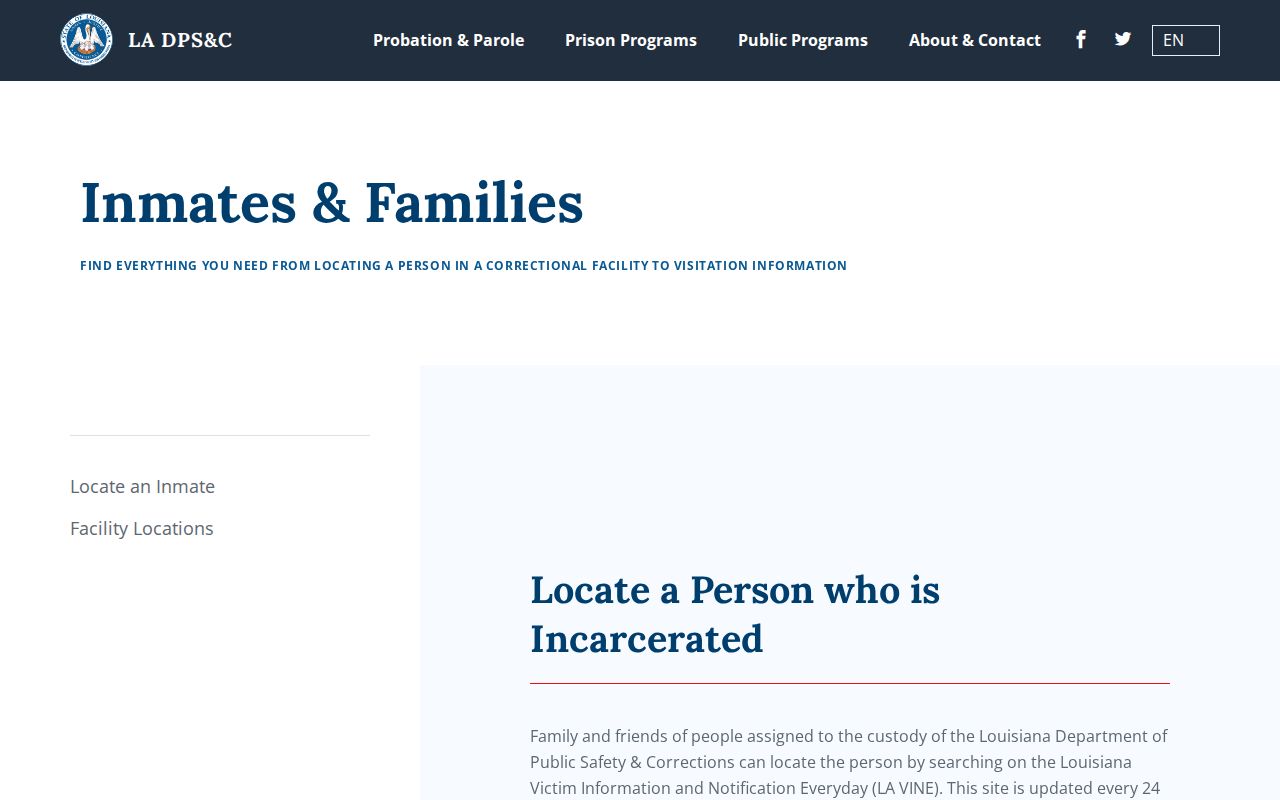
That daily cadence makes the locator a verification snapshot, not a real-time record of the moment someone walks out.
Requesting Louisiana Release Records
When an online result is absent or too vague, request a narrow record from the agency that made the movement. Louisiana Public Records Law allows inspection and copying of public material subject to statutory exceptions. It also permits the custodian to ask for enough detail to identify the record. Parish procedures and copy charges vary, so a local request should go to the sheriff or jail records custodian. For a state record, DPS&C directs written requests to the Deputy Secretary's Office at P.O. Box 94304, Baton Rouge, LA 70804, by fax at 225-342-3095, or by email at docpublicrecords@la.gov. The public-information phone is 225-342-6744.
- Identify the last known parish jail, state facility, or other custodian before choosing the records office.
- Give the full name, known booking or DPS&C number, and a useful date range.
- Ask for the specific releasable item, such as a release entry, movement log, or date and receiving authority.
- Ask the custodian to segregate public portions if part of the requested material is exempt.
- If availability is denied or disputed, request the written determination and legal basis required by state law.
DPS&C institutional files are confidential under R.S. 15:574.12, apart from limited information identified by the agency. A request for an entire master file is therefore different from a focused request for releasable release information. Sentence-computation questions also use a separate route, not the public-records mailbox. Louisiana does not publish a universal retention rule for every parish release product or a promise that all discharged people stay in LA VINE.
Can the agency charge just to inspect a public record? R.S. 44:32 says a custodian may not charge merely for review or examination. Copy fees may still apply under the relevant custodian's process.
Note: If a records dispute remains, the custodian's written determination and legal basis are due within five business days under R.S. 44:32.
Louisiana Release Records and Law
The Louisiana Constitution provides the foundation for public access, while the Public Records Law supplies the operating rules. R.S. 44:1 defines public records broadly, subject to exceptions. R.S. 44:31 gives adults a right to inspect, copy, or reproduce records and lets any person obtain a copy. The custodian bears the burden of proving that an exemption applies. R.S. 44:32 permits identity and age checks, allows a request to be narrowed, calls for separation of public and exempt parts, and sets the written-response rule when availability is disputed.
Key Louisiana rules:
R.S. 44:1 defines the records covered by public-access law, with statutory exceptions intact.
R.S. 44:31 states the inspection and copy rights and places the exemption burden on the custodian.
R.S. 44:32 governs specificity, examination, segregation, disruption, and written determinations.
Sealed, expunged, juvenile, and confidential corrections material can fall outside ordinary public access. A narrow request gives the custodian a better chance to find the public part without sweeping in protected material. It also makes clear whether the needed fact is the date of physical release, the legal reason for it, a transfer destination, or the end of supervision.
Louisiana Release Cohort Trends
Official DPS&C recidivism tables current through June 30, 2024 report five defined release cohorts. The count fell from 13,150 in 2018 to 9,366 in 2021, then rose to 9,834 in 2022. The 2022 cohort was still 25.2 percent below 2018. These are not transaction totals for 2024. They cover releases from adult institutions, local facilities, and transitional work programs under the report's definition, and a person can appear once in each release year.
The definition excludes detainers, erroneous releases, deaths, and transfers to another jurisdiction. That boundary matters because raw movement counts can mix community releases with events that kept a person confined elsewhere.
The official DPS&C data-download page groups the agency's incarceration snapshots, admissions, releases, and other series.
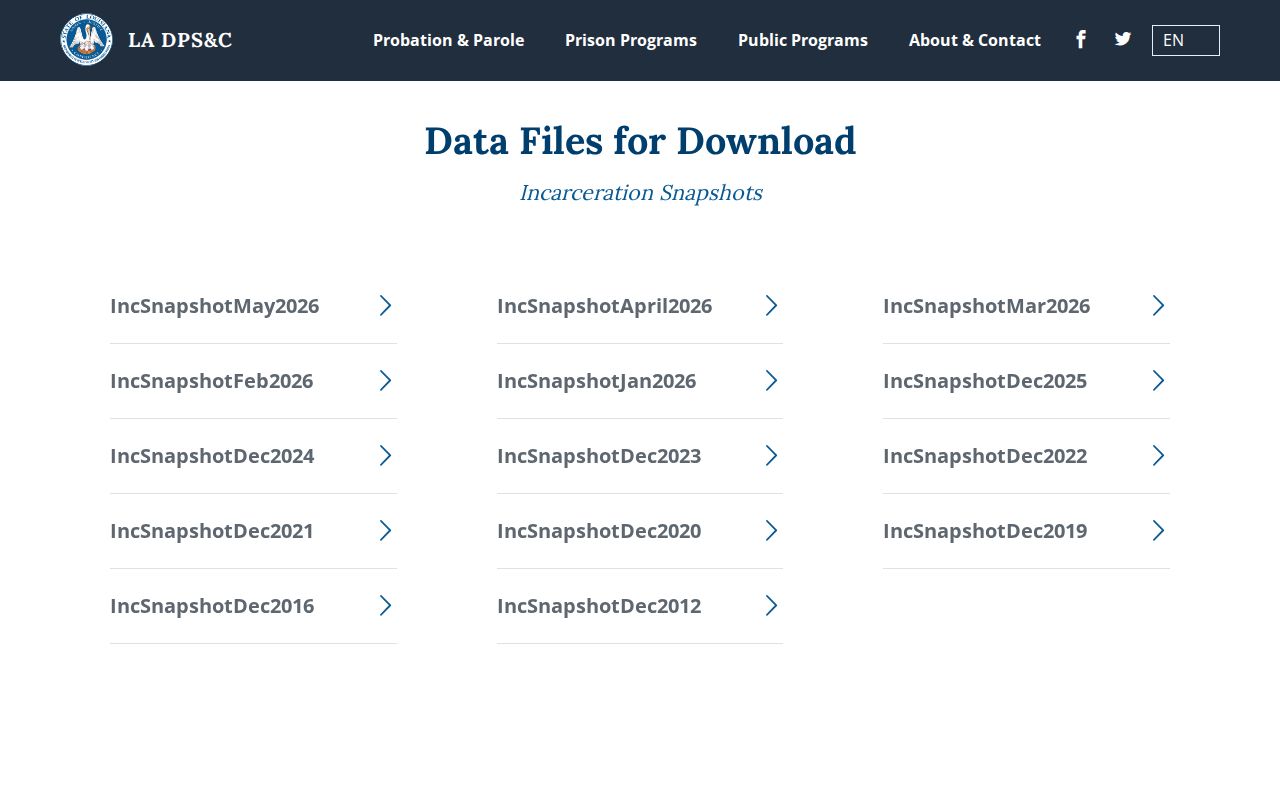
The dated files support statewide trend work, but they cannot verify the release status of one named person.
Louisiana Release-Day Aid
Louisiana law authorizes concrete but limited aid for some people leaving state prison. R.S. 15:866 lets the DPS&C secretary set eligibility rules for temporary maintenance, capped at $20. It does not promise that amount to every released prisoner. R.S. 15:866.1 likewise provides for transportation under agency rules to an eligible person's Louisiana residence, but it excludes transport to an out-of-state residence. These statutes define authority and limits, not a universal gate package.
R.S. 15:866.2 permits specified account interest to aid indigent people who have left physical custody and remain under Probation and Parole supervision. Listed uses include identification, counseling, transportation, and education. Eligibility still controls. A dated DPS&C brochure also says people leaving on good-time or granted parole must report to the office printed on the parole certificate. Current instructions should come from the certificate and live district locator.
Note: Release-day aid and transport depend on DPS&C rules and eligibility; neither statute creates the same benefit for every release.
Search for Louisiana Released Inmates
A sound statewide search follows custody rather than assuming every person appears in one database. Start with the last place that physically held the person. If it was a parish jail, look for a local recent-release or movement record. If a state sentence may be involved, check LA VINE and the DPS&C telephone locator. Court minutes can explain the order behind the move. Federal prison and immigration custody have their own systems. A no-result screen is a lead to check identity and jurisdiction, not proof of discharge.
- Confirm the person's full name, date of birth, known agency number, and last known place of custody.
- Check the holding parish's current or recent product, then request its movement record if the person has vanished from the roster.
- Search Louisiana LA VINE by exact name or ID and compare the reporting agency, location, event, and update date.
- Call the DPS&C locator at 225-383-4580 when a state sentence, local placement for a state prisoner, or community supervision is possible.
- Read the sentencing court's minutes and follow any named parish, DPS&C, BOP, USMS, or ICE receiving authority.
- Send a narrow records request when the online sources do not settle the physical release or discharge question.
The 64-parish route begins with the Louisiana County Directory, which points to the local source and release-record process for each parish. The legal name in Louisiana is parish, though the directory label follows the site's statewide navigation convention.
DPS&C Search for Louisiana Releases
DPS&C sends the public to Louisiana LA VINE rather than promising a static archive of fully discharged people. The search accepts a location, name, or ID/case number. Results should be matched with care. Read the reporting agency and exact status or event, then check the event and update dates. A person under probation or parole can remain visible after physical confinement ends because community supervision is included. Fully discharged people are not guaranteed to remain in public results.
| Search input or result | How to use it |
|---|---|
| Exact name | Begin the person search, then compare other identifiers to avoid a same-name error. |
| ID or case number | Use the most exact agency identifier available. |
| Location or reporting agency | Identify which custodian supplied the record. |
| Status or event | Preserve the source's exact wording instead of converting it to a broader claim. |
| Event and update dates | Separate the dated event from the age of the current snapshot. |
The public Louisiana LA VINE person search is the web entry point cited by DPS&C.
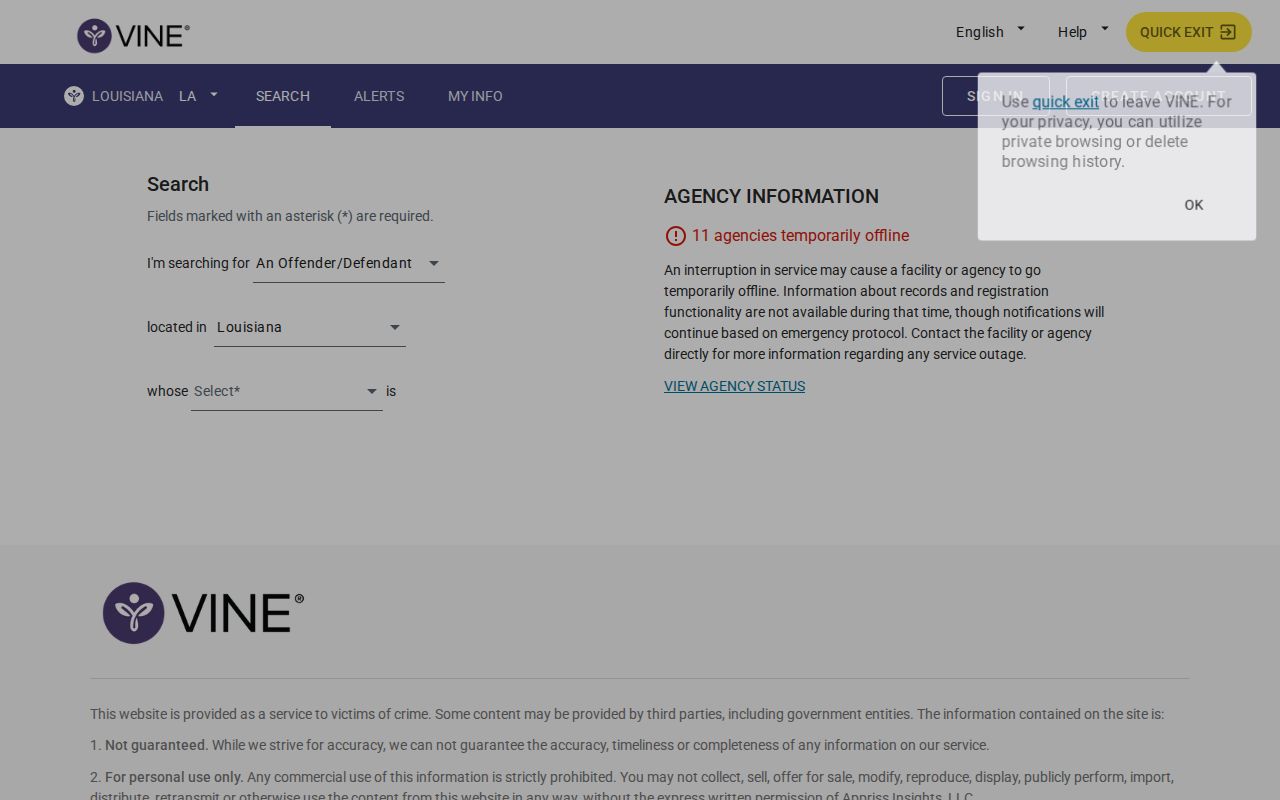
The interface can show participating-agency information, while its result scope and fields may vary by contributor.
For the state-only process, the DPS&C offender search treatment explains the web and phone routes, limits on historical results, and the distinction between release and full discharge.
Parish Variation in Louisiana Releases
Louisiana's parish systems do not publish one common recent-release feed. Research across all 64 parishes found sheriffs with 24-hour, 48-hour, or 72-hour released views, others with current rosters only, and offices that require a records request. A live roster is built to show present custody. Once a person leaves it, the local movement record, court minutes, statewide locator, or receiving agency becomes more useful.
State-sentenced people may also be housed in local jails. Their removal from a sheriff's list might mark transfer within DPS&C legal custody rather than the end of the state sentence. Louisiana's broader facility map includes parish prisons, municipal and regional jails, state institutions, federal complexes, transitional work programs, and ICE contract sites. The first record should come from the place that held the person. The final conclusion should follow the agency that took control next.
Note: No single roster covers Louisiana releases, and a local feed's time window or missing entry should not be treated as a statewide finding.
Louisiana Court Records and Release
Court records answer the legal side of a release. Minutes may show bond, dismissal, sentence, credit, probation, revocation, or commitment. They may not show the exact gate time. The physical event remains a fact for the jail, prison, or receiving custodian to confirm. This split is useful when an online jail roster shows no current result but the case still has an active sentence or transfer order.
The eClerks LA portal provides a statewide court-access route, but it is not a corrections locator.
For criminal cases filed on or after January 1, 2020, R.S. 13:5992 requires public electronic access to minute entries or summaries, not every pleading or image. Older files, certified copies, and missing material still go to the parish clerk.
Louisiana Publication and Release Records
Louisiana has two distinct protections for published arrest and criminal-history material. Code of Criminal Procedure article 234 applies to businesses that publish booking photos and charge for removal. After a qualifying acquittal, no prosecution, expungement, vacatur, or pardon, a supported request triggers removal and destruction within seven calendar days without a fee. Ordinary release by itself is not one of the listed outcomes.
R.S. 14:133.7 separately addresses criminal-history publication, including sentencing, correctional supervision, release information, and arrest photographs. It restricts publication after notice of expungement or nondisclosure, bars charging to remove or correct covered information, and requires a dispute contact and review within thirty business days. Its focus on a complete and current disposition is one reason an old arrest image or release entry should never stand alone as the whole record.
Louisiana Parole Discharge Records
Physical release and the end of parole are separate events. Louisiana Board policy says a parolee receives a Certificate of Discharge when the sentence completes. Under R.S. 15:574.6, full-term discharge is automatic only when no Committee warrant, Probation and Parole detainer, or pending felony charging instrument blocks it. The certificate is therefore stronger proof of parole completion than a years-old prison release date.
Probation has a different endpoint because it is imposed and ended through the court. A general claim that someone is “off supervision” can blur that line. Check the DPS&C community-supervision result or assigned district for parole status, and use the sentencing court for probation completion. For state-prison notices, eligible registrants must also distinguish ordinary LA VINE registration from formal Louisiana Victim Outreach registration.
The DPS&C Victim Services page explains the LA VINE and LAVO roles.
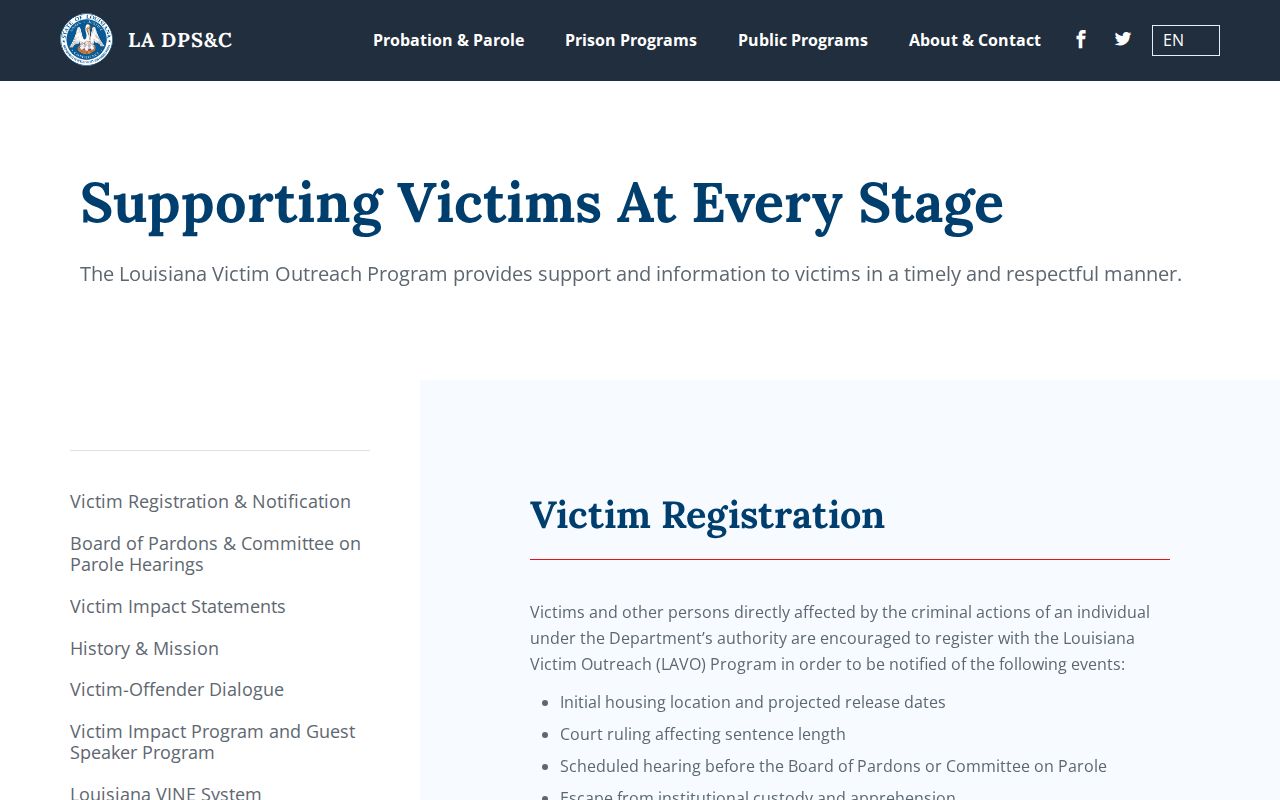
Its distinction matters because a public locator alert and formal state-prison victim notice do not provide the same set of updates.
The separate LAVO registration page sets out the formal registration path.
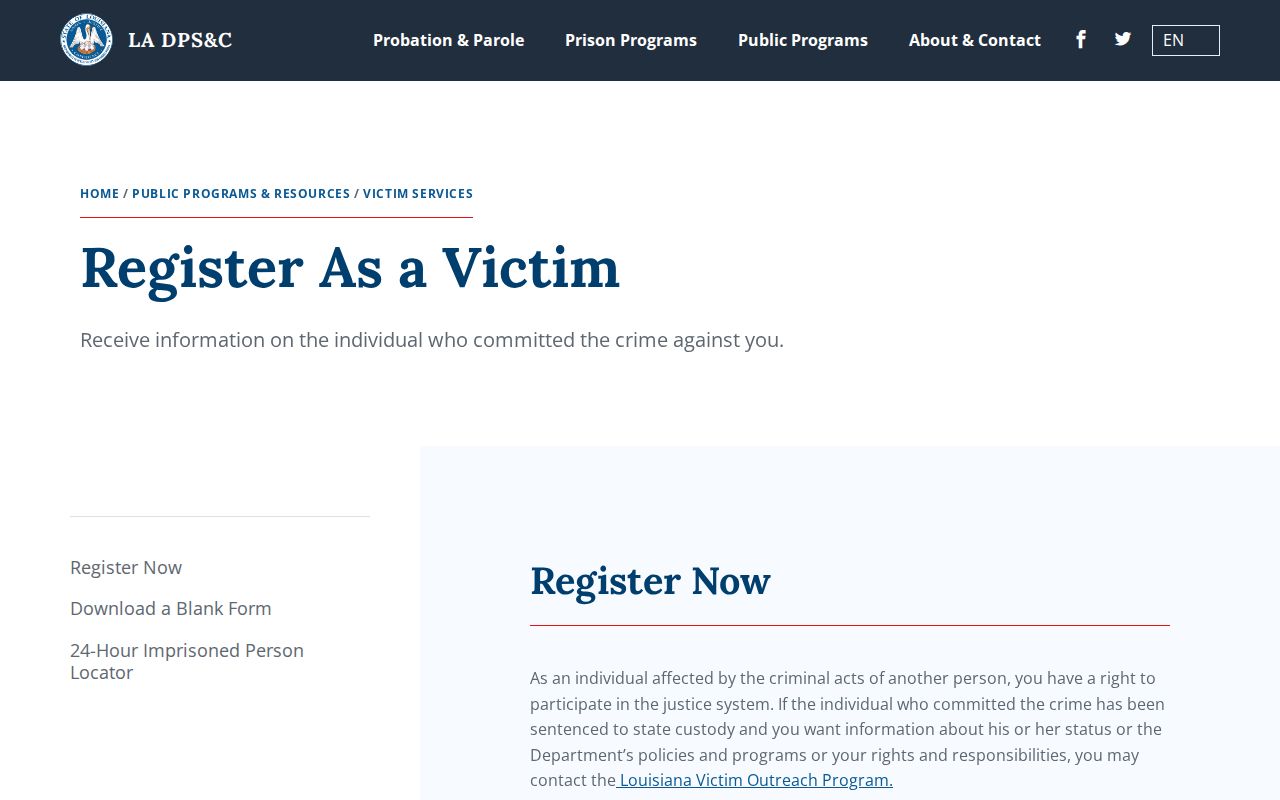
Accurate and current contact information is part of that process, and registration must match the notice route the person is eligible to use.
Federal and Immigration Release Checks
Federal prison and immigration systems require their own checks. The BOP locator covers federal records from 1982 onward. It accepts federal identifier types or a name with demographic filters. Results can show a past or projected release date, location, and labels such as “RELEASED” or “Not in BOP Custody.” A past date with no facility means release from BOP custody on that date. It does not answer whether another sovereign held the person next or whether federal supervised release continues.
The official BOP Inmate Locator is the released-person route for a federal prison sentence.
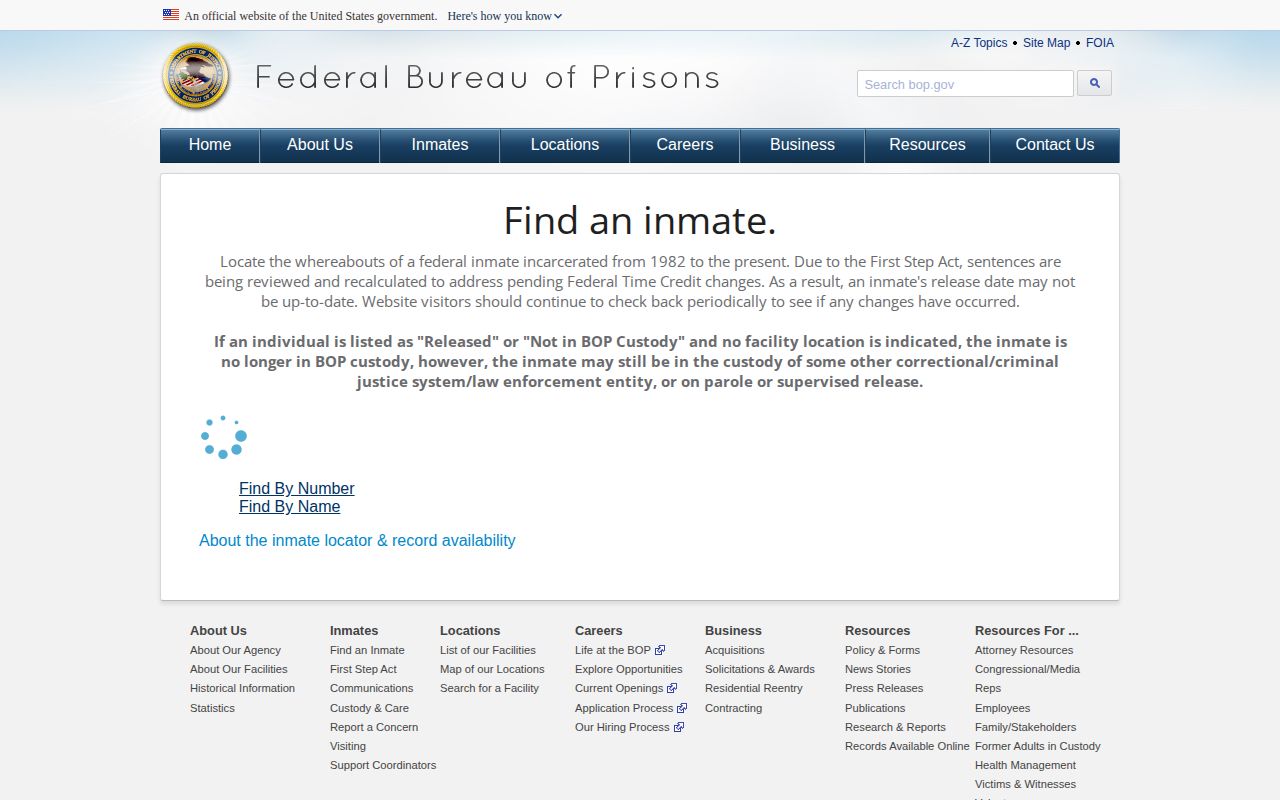
BOP extracts data daily, and later sentence calculations can change a future projected date.
ICE's locator is current-custody oriented. It covers people in ICE custody and people held by CBP for more than 48 hours, with exact-match rules and no public records for those under 18. A failed search is not proof of release because a record may be delayed or withheld. An ICE detainer is only a request for another agency to hold a person up to 48 hours beyond ordinary release. It does not prove that ICE took custody. Confirm the jail handoff and then check ICE or its information line.
Note: “Not in BOP custody,” no ICE result, and absence from a parish roster each answer different questions about Louisiana custody.
Louisiana Released or Still Held
The best source changes with the custody layer and the event being tested. A current parish roster answers who is held there now. A parish movement record can show departure and the receiving authority. LA VINE can reflect prison, local-agency, or community-supervision data supplied by participants. The DPS&C phone locator can return state placement and a projected release date when applicable. Court minutes establish legal authority, while federal and immigration tools cover their own systems.
| Source | Best use | Main limit |
|---|---|---|
| Parish jail roster | Confirm current local custody | A released or transferred person may disappear |
| Parish movement record | Confirm local departure and possible destination | Must be requested in some parishes |
| LA VINE | Check participating custody or community supervision | Updates every 24 hours and fields vary |
| DPS&C phone locator | Check state placement and projected date if applicable | Not a permanent discharge archive |
| Court minutes | Confirm bond, sentence, dismissal, probation, or transfer authority | May not show the exact physical release time |
| BOP or ICE | Check federal prison or current immigration custody | Each system answers only its own custody question |
What if LA VINE returns no result? Recheck spelling and identifiers, identify the last physical custodian, and follow the parish, court, federal, or immigration record. No result does not establish that a person was never held or is fully discharged.
Public Record Search
Sponsored Results