
DPS&C Released-Inmate Authority
The official agency name is the Louisiana Department of Public Safety & Corrections. Its masthead uses DPS&C and LA DPS&C. “LDOC” is not the official short form. DPS&C oversees the state prison system, sentence calculation, release from state custody, and the Division of Probation and Parole. Yet its public lookup does not work like a fixed historical database. The agency sends the public to Louisiana Victim Information and Notification Everyday, known as LA VINE, for location and status information.
The DPS&C home page shows the official agency identity used in state records.

That branding matters when a search result or records response names the legal custodian. A parish sheriff, DPS&C, the federal Bureau of Prisons, and ICE keep separate records. Departure from one roster may be a transfer to another custodian, not release to the community.
Use the DPS&C Offender Search
DPS&C directs users to the Louisiana LA VINE person search. The agency says the data include people in prison and people on probation or parole in the community. Updates occur every 24 hours. Search by the most exact name or ID available, then match the agency and other identifiers before relying on a record. A similar name alone is weak proof.
- Open Louisiana in LA VINE and choose the person search.
- Enter the exact name or an ID or case number. Use location only when it helps narrow a common name.
- Open the matching record and compare the reporting agency, location, status or event, date, and update marker.
- Follow any receiving agency named in a movement record. Confirm community supervision with the assigned DPS&C district.
- If no useful result appears, call the automated DPS&C locator or request a narrow record from the correct custodian.
The LA VINE interface is the public DPS&C offender-search destination.
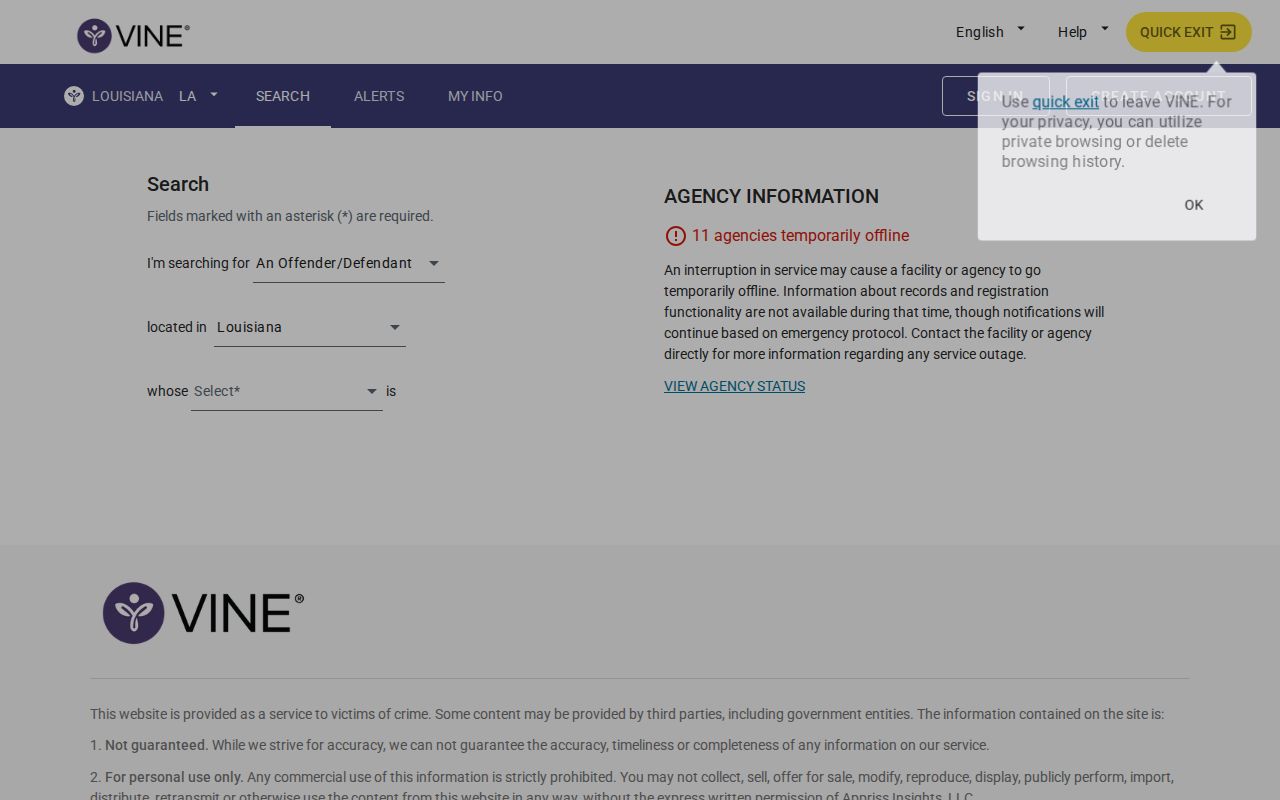
The interface can carry records from participating agencies, so read the source and its exact words. Do not turn an agency event into a broader claim. A release or out-of-custody event proves departure from that reporting custodian only.
A sound verification trail begins with the last known facility. Check its roster or recent-release product, then search LA VINE for a state or community record. Call the DPS&C locator when a state sentence is possible. Court minutes can explain a bond, dismissal, sentence, credit, probation order, revocation, or commitment. If the record names another authority, search that system next. Only after those checks should a narrow records request fill the remaining gap. This sequence separates “not in this jail” from “fully discharged.”
DPS&C Release-Result Limits
DPS&C confirms that community supervision is included, which is useful after a prison gate release. It does not publish a stable result-card format for all fully discharged people. The agency does not promise an indefinite retention period, a universal “Released” or “Discharged” label, or a release-type field on every web record. No result can stem from a spelling mismatch, a parish-only booking, feed lag, another sovereign, or the end of the system's public scope.
Read only what a live record says. Save the date of retrieval. A community-supervision status means confinement has ended while part of the sentence or court order continues. Parole means serving the balance of a prison sentence in the community. Probation is ordered by a court and is not the same as parole. Full discharge is best shown by the final agency or court document, not by silence from a search.
| Observed item | Safe reading |
|---|---|
| Reporting agency | Identifies the custodian or contributor whose record is being viewed. |
| Location | Shows the place or supervision unit stated by that contributor. |
| Status or event | Must be preserved exactly; it may describe custody, movement, or community supervision. |
| Event date | Dates the reported event but should not be renamed as final discharge without support. |
| Update marker | Shows the age of the snapshot in a system that DPS&C says updates every 24 hours. |
| No result | Does not prove release, discharge, or lack of prior custody. |
Note: Fully discharged-person persistence and a statewide historical retention period are not published, so neither should be promised.
DPS&C Release-Date Phone Locator
The independent state route is the automated Imprisoned Person Locator at 225-383-4580. A caller supplies the DPS&C number, or the person's name and date of birth. DPS&C says the line can provide the facility placement, address and telephone number, and a “projected release date (if applicable).” The agency FAQ also says it may identify the calculated date or the assigned Probation and Parole district office.
The DPS&C Inmates & Families instructions document the locator inputs and update cycle.
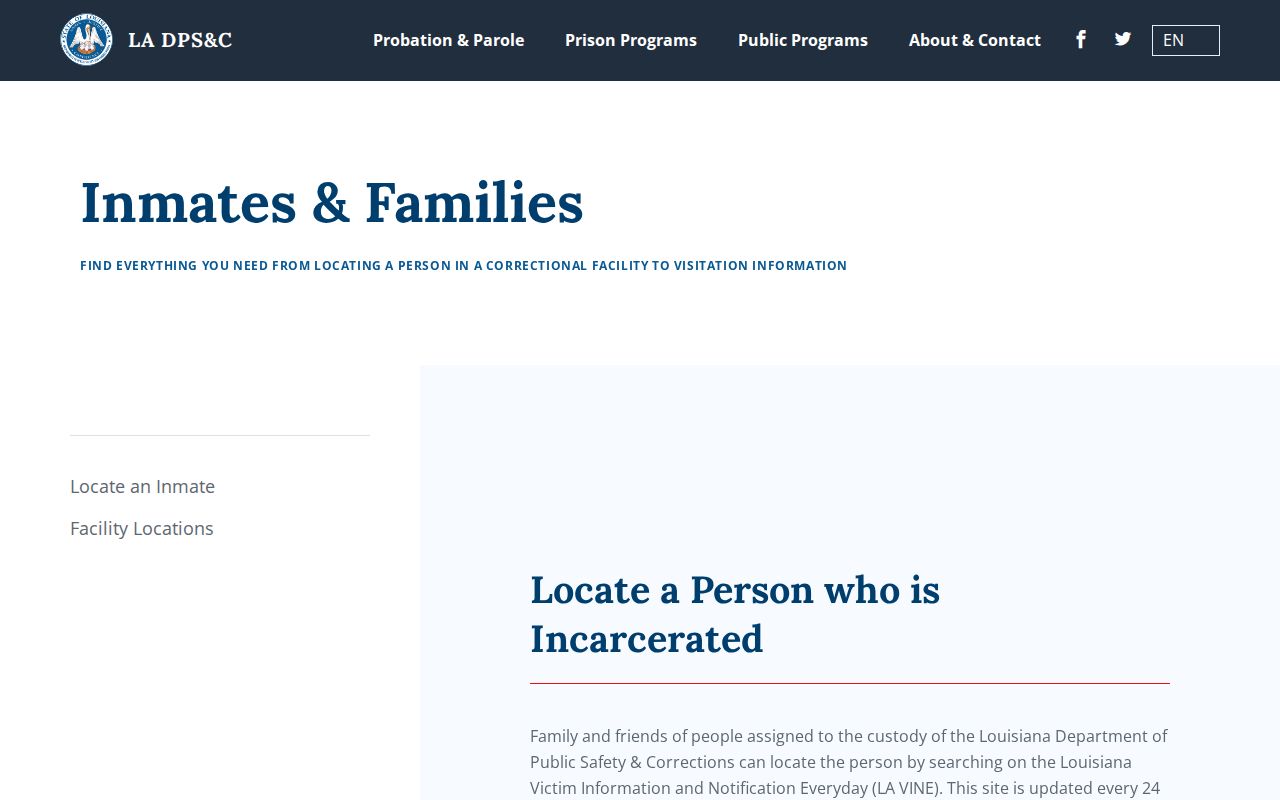
This is the verified public channel for the agency's exact projected-date wording. The research does not establish that the same field always appears online. If a newly sentenced case has no date, DPS&C may still be waiting for official court papers or finishing its calculation. Sentence-computation questions go to 225-342-0799.
Louisiana Prison Release and Discharge
Louisiana law separates a physical exit, supervised release, and sentence completion. A state prisoner may complete the sentence, receive discretionary parole, leave through good-time diminution, or begin probation under a split sentence. Under the older diminution law, R.S. 15:571.5 treats an eligible good-time release as parole for the balance of the original term. Conditions are listed on a certificate, and a violation can lead to revocation and return to custody.
For eligible offenses committed on or after August 1, 2024, R.S. 15:571.3.1 generally places the remaining term on unsupervised parole after good-time release. Split-sentence probation can begin at once and run at the same time. The offense date, conviction, sentence, prior record, credits, and exclusions govern. A single online formula cannot safely replace the official calculation.
- Parole
- The rest of a prison sentence served in the community under stated conditions.
- Probation
- Court-ordered supervision that is imposed and ended through the court.
- Discharge
- The formal end of a sentence or supervision term.
- Detainer
- A request or notice that another authority may take custody.
A favorable parole decision is not the same as release. The Committee can set a date, but the decision may change until the parole certificate is signed and actual release occurs. Compare the decision with the facility status, LA VINE, and the assigned district. The statewide Parole Board Hearings page explains the docket and results trail.
A dated 2019 DPS&C release brochure says people leaving on good-time parole or granted parole must report in person within 48 hours to the office printed on the parole certificate. It also says a proposed move to another state should be raised before release, and that leaving Louisiana requires permission. The broad process helps explain why the certificate matters, but current office details must come from the live P&P district locator and the person's current paperwork.
Louisiana Release-Day Aid Limits
Louisiana has specific, narrow release-day aid laws. R.S. 15:866 authorizes the DPS&C secretary to set eligibility rules for temporary maintenance, capped at $20. It does not give every released prisoner an automatic $20 payment. R.S. 15:866.1 likewise provides transportation under eligibility rules to a person's Louisiana residence. It excludes a trip to an out-of-state home.
A related law permits certain account interest to help an indigent person who has left physical custody but remains under Probation and Parole supervision. Listed uses include identification, counseling, transport, and education. The statute creates authority for aid, not a personal guarantee. The release certificate and current agency instructions remain the sound source for what applies to one person.
The place of release also does not determine the person's final legal status. Louisiana's cohort definition includes people leaving adult institutions, local facilities, and transitional work programs. A state-sentenced person may have been housed in a parish facility before DPS&C release, while a transitional-work participant remained in legal custody despite structured time in the community. Confirm the DPS&C number, the releasing site, the stated event, and the supervision record. Those four points keep release-day aid, physical departure, and sentence discharge from being merged into one unsupported conclusion.
Note: Release-day help is based on agency rules and eligibility; general claims about guaranteed cash, clothes, or travel are not supported.
DPS&C Released-Inmate Cohort Trends
The official June 30, 2024 recidivism table reports five release cohorts. Its definition includes releases from adult institutions, local facilities, and transitional work programs. Completed sentence, parole, conditional release, and split-probation sentence are included. Detainers, errors, deaths, and transfers to another jurisdiction are excluded. One person can appear once in each release year.
| Release cohort | Count | Reading |
|---|---|---|
| 2018 | 13,150 | Defined release cohort, not all custody movements. |
| 2019 | 12,973 | Measured under the same stated cohort rules. |
| 2020 | 10,693 | Annual cohort in the official table. |
| 2021 | 9,366 | Lowest of the five reported cohorts. |
| 2022 | 9,834 | Rose from 2021 but remained below 2018. |
The DPS&C data-download page provides official release series.
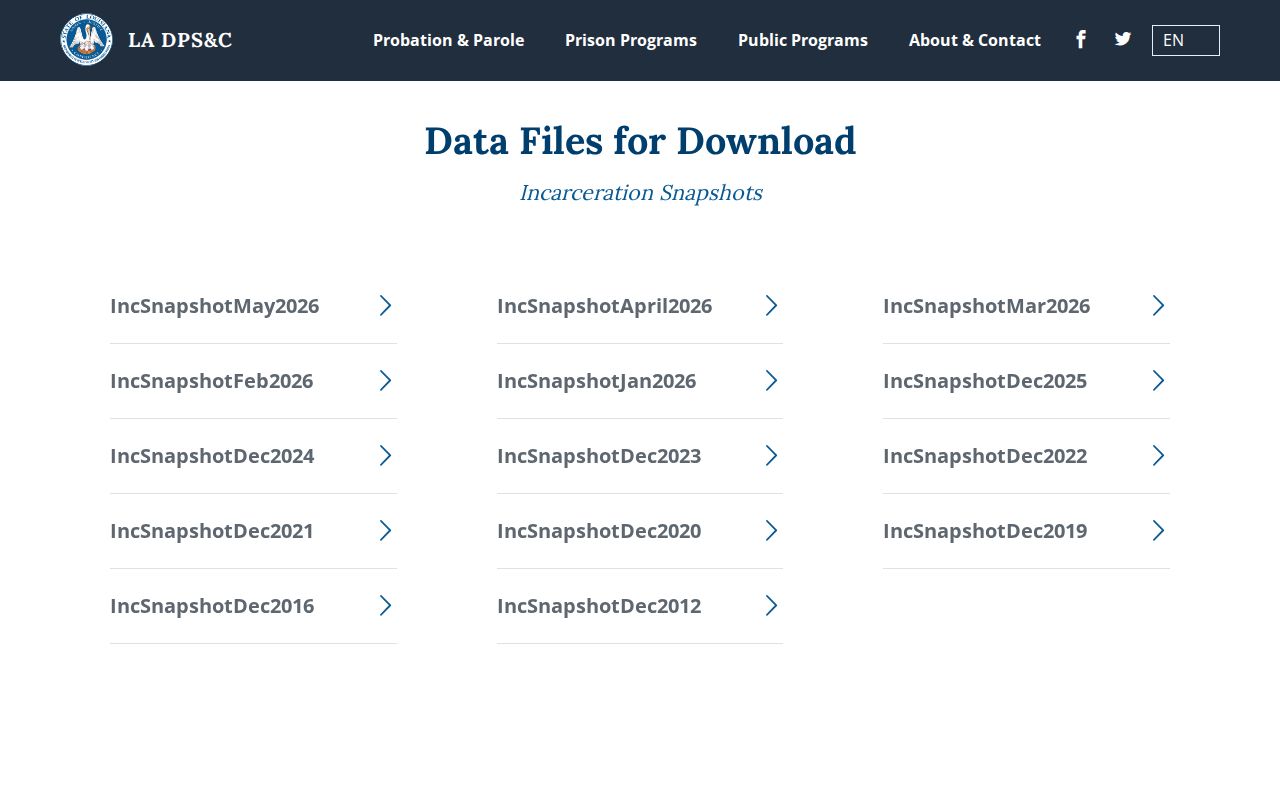
These figures describe groups, not any named person. The 2022 number is not a count of 2024 releases. Trends also do not prove why a person returned or what caused a statewide change.
The table reports a 28.8% fall from the 2018 cohort to 2021, followed by a 5.0% increase in 2022. The 2022 cohort still remained 25.2% below 2018. Those comparisons are valid only within the report's cohort definition. The same source measured return rates for the 2019 cohort at 13.0% within one year, 22.8% within two years, 30.3% within three years, and 35.9% within four years. Later cohorts have less follow-up time, so their rates should not be placed beside the older cohort without that limit.
Route Louisiana Release Records
The DPS&C offender search is for the state custody and community-supervision path. Parish sheriffs keep booking, release, and movement records for their jails. A person sentenced to state custody may still be housed in a local facility, so follow the legal custodian as well as the building. Transitional work also remains legal custody even when structured activity takes place outside the facility.
| Situation | First record | Next check |
|---|---|---|
| State prison or state sentence | LA VINE and DPS&C phone locator | Facility, court minutes, or assigned P&P district |
| Parish booking or sentence | Sheriff roster, release view, or movement record | Parish clerk and LA VINE when state custody may follow |
| Federal prison | BOP Inmate Locator | Federal docket or U.S. Probation |
| Immigration custody | ICE Online Detainee Locator | ERO and the releasing jail's movement record |
The County Directory routes a parish-level inquiry. If a local record says transfer, identify the receiving authority before describing the event as community release. An ICE detainer is only a request to hold for possible pickup and does not prove that ICE took custody.
For a federal sentence, the BOP Inmate Locator covers records from 1982 forward. A past release date with no facility means BOP says release occurred on that date, while a future date is projected. “RELEASED” or “Not in BOP Custody” ends only the BOP custody question. It does not rule out another sovereign's custody or federal supervised release. ICE's Online Detainee Locator has the opposite emphasis: it is mainly a current-custody tool, and a failed exact-match search does not prove release. The prior jail's movement record is still needed to confirm a handoff.
Request DPS&C Release Records
DPS&C directs written public-record requests to the Deputy Secretary's Office, P.O. Box 94304, Baton Rouge, LA 70804. Requests may also be sent by fax to 225-342-3095 or email to docpublicrecords@la.gov. The office phone is 225-342-6744. Ask for an identifiable public record, not a general explanation or a new sentence calculation. Include the full name, DPS&C number when known, a date range, and the specific release or movement record sought.
The agency says institutional files are confidential under R.S. 15:574.12, apart from limited information such as age, offense, conviction date, sentence length, and misconduct while imprisoned. Do not demand the entire master file. Under R.S. 44:32, the custodian may seek enough detail to find the record and may verify age or identity. Inspection itself is not subject to a review fee. If access is disputed, the custodian must give a written decision and legal basis within five business days, excluding weekends and legal holidays.
The Master Prison Record is a different item. DPS&C sends it to an imprisoned person when sentence calculation is complete. It can contain the calculation and a work-release eligibility notation. A person in a state facility raises a calculation issue through the facility Records Office; a state felon held locally uses the written Administrative Remedy Procedure. Public-record staff should not be asked to perform that calculation.
Louisiana's general access rules define public records broadly, subject to statutory exceptions, and place the burden of proving an exemption on the custodian. Public and confidential parts should be separated when that can be done. A request may be narrowed if it would substantially disrupt office work, but the custodian must first make reasonable efforts to help define the records. A focused request for a dated movement or releasable status record is therefore stronger than a demand for every document in an institutional file.
R.S. 15:571.3 also calls for an annual report by August 1 on releases under its good-time provision during the prior fiscal year. The law specifies release, offense, and program data and requires juvenile redaction. If the report is not posted, it can be named as a focused public-record target. This route seeks an existing statewide record and does not ask staff to calculate a named person's sentence.
Public Record Search
Sponsored Results