
Louisiana Parole Board Authority
The statewide body is the Louisiana Board of Pardons & Committee on Parole. The Committee on Parole consists of the five Board members plus two at-large members and is Louisiana's sole parole-granting authority. Pardons and parole share an administrative home, but they are not the same remedy. The Committee decides whether an eligible imprisoned person may serve the rest of a sentence in the community under a parole certificate.
A hearing sits between eligibility and possible release. It does not erase the sentence, and it does not itself open the prison gate. A favorable vote can lead to a set date and conditions, while an unfavorable or delayed outcome keeps the matter in custody or under later review. Louisiana reports that hearings are usually scheduled within nine months of eligibility, yet the named docket remains the source for a specific proceeding.
The Board of Pardons handles a separate form of relief. A pardon record therefore should not be read as a parole vote, and a parole docket should not be used to answer a pardon question. The shared agency name makes this easy to confuse. Follow the heading, panel, and proceeding type shown on the official notice.
The Committee's role is also distinct from sentence calculation. DPS&C calculates the operative dates after it receives the necessary court papers. The Committee applies parole law and discretion when an eligible matter comes before it. A facility maintains present custody until release. Keeping those roles separate makes it clear which office can correct a date, explain a docket, or confirm the physical event.
The DPS&C home page shows the department within which Louisiana publishes pardons and parole material.
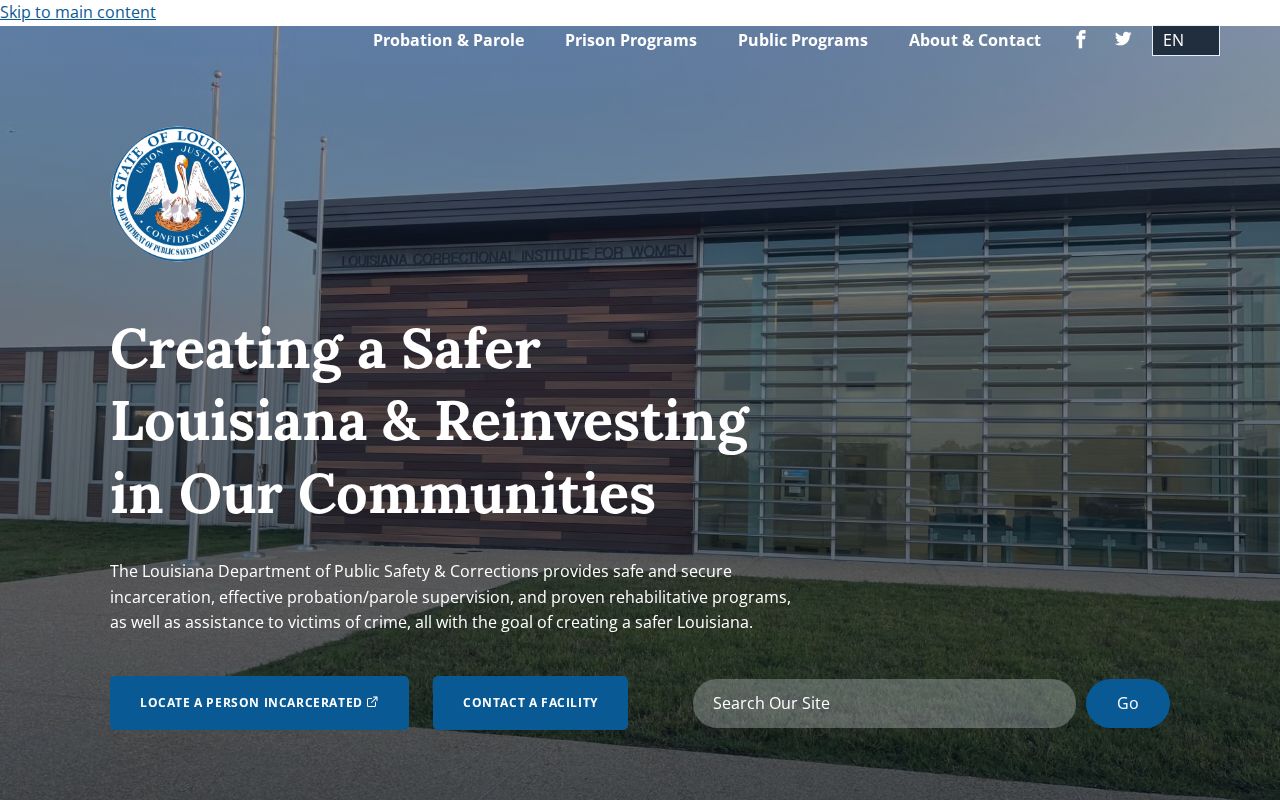
The official masthead also confirms DPS&C as the proper agency abbreviation.
Find a Louisiana Parole Hearing
Louisiana's annual schedule and rolling docket answer different parts of the date question. The 2026 annual schedule maps recurring panel dates to institutions or parish matters. It says panels normally sit at DPS&C headquarters unless the entry says otherwise. The rolling parole docket page supplies person-level hearing-week notices.
- Use the annual calendar to identify the institution's scheduled panel date or likely month.
- Open the rolling docket page and choose the matching hearing week. The annual calendar does not list every person's name.
- Search the PDF for the exact name or DPS&C number, then confirm the facility and hearing date.
- Read the notice for the current participation method and location. Video, YouTube, Zoom, and in-person access depend on that notice.
- Return after the hearing to locate the results version instead of assuming the agenda records the outcome.
When reviewed on August 12, 2026, the rolling page held hearing weeks from January through August 11 through 14 and an archive for 2025. That observation supports a rolling weekly pattern, not a promised posting deadline.
The official rolling docket page provides the current weekly notices.
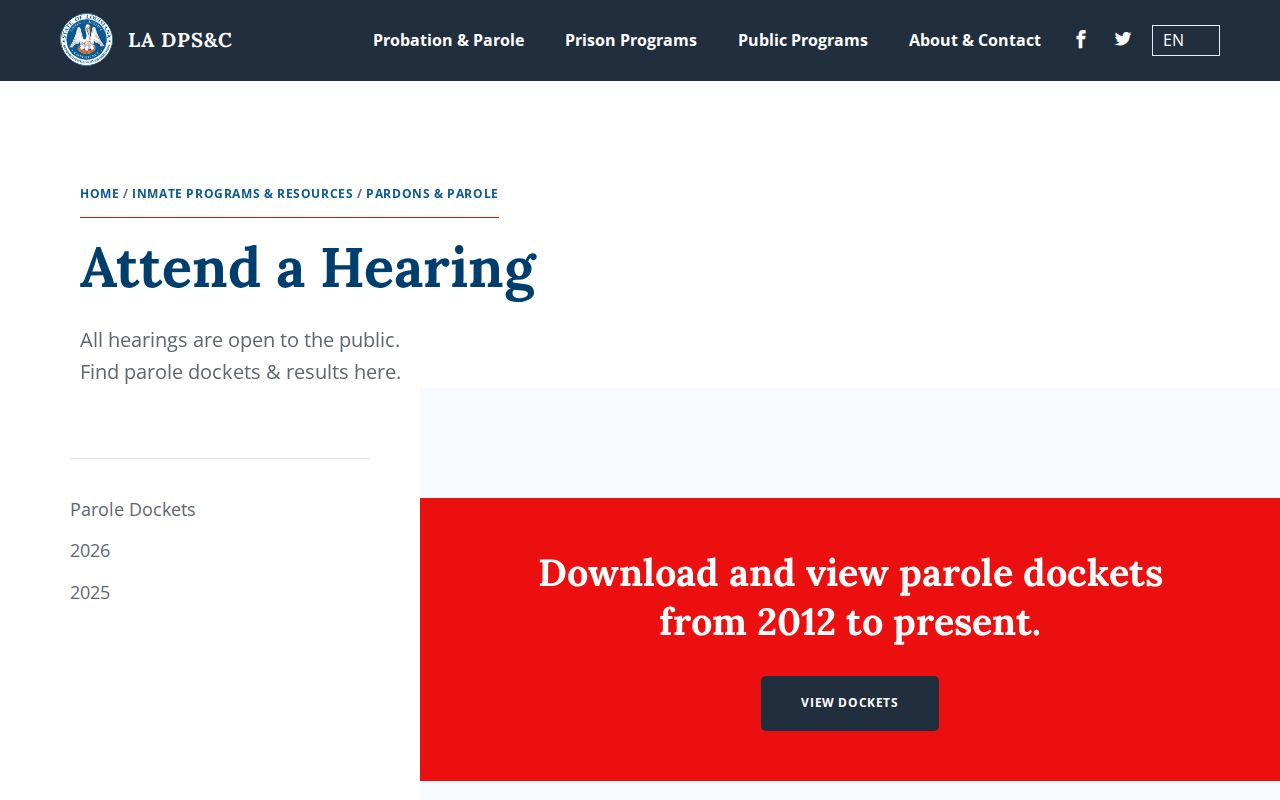
The page is the bridge from the broad annual rotation to a named person's proceeding.
Find Louisiana Parole Decisions
The official docket and results database can be browsed by year, month, hearing date, and location. The research verified entries from 2012 through 2026. Some dates and locations appear twice, apparently because one entry is the agenda and another is the updated results file. The attached PDF, not the row label alone, determines which one carries the decision.
- Choose the year, month, hearing date, and location that match the named docket.
- Open each attached PDF when duplicate entries appear. Identify the document as an agenda or results attachment.
- Match the person's name and DPS&C number before reading any disposition.
- Record the exact result language and hearing date. Do not translate an unfamiliar label into a grant or denial.
- If no result is posted, contact Board staff after the hearing at 225-342-9191 or 225-342-6622.
The legacy results database exposes the years, search route, and attachments used for this check.
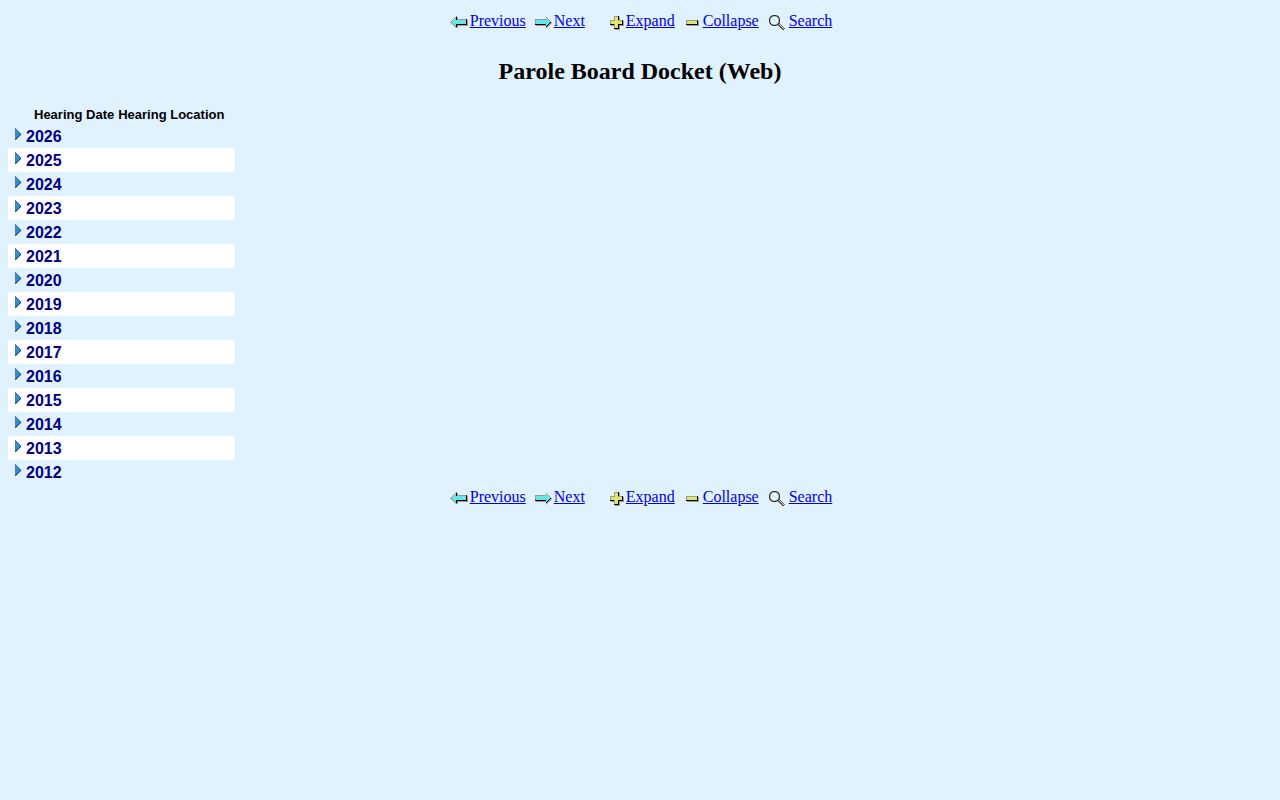
Its layered structure is why the correct PDF must be opened before reporting an outcome.
Save the hearing date, location, and attachment title with the result. A later file can revise the public picture, and two people with the same name may appear in different years. The DPS&C number is the clearest match key when it is published. If it is missing, compare the institution and proceeding date before reaching a conclusion.
If the results attachment remains unavailable, a focused inquiry should name the person, DPS&C number, hearing date, and location. Board staff can then identify the disposition without searching an entire year of dockets. A broad request is more likely to return the wrong hearing or an agenda that lacks the final action.
Louisiana Parole Hearing Outcomes
Decision categories describe the Committee's action at a stage in the process. They do not all establish a final custody event. A grant is discretionary and may carry conditions. Under R.S. 15:574.4.1, the Committee can modify or rescind the decision until the parole certificate is signed and actual release occurs. A denied case may later return under the applicable rehearing rule. Any other disposition must be read exactly as the official results file states it.
| Decision stage | Meaning | Next verification |
|---|---|---|
| Granted | The Committee approved parole, subject to the decision and certificate | Check the set date, signed certificate, and actual custody status |
| Denied | Parole was not granted at that hearing | Read the result and current rehearing policy |
| Another stated disposition | The results file uses a term other than grant or deny | Quote the exact result and follow its next step |
| Pre-release change | An earlier favorable action may still be modified or rescinded | Use the latest Committee record and facility status |
The Louisiana LA VINE search is one source for that later status check.
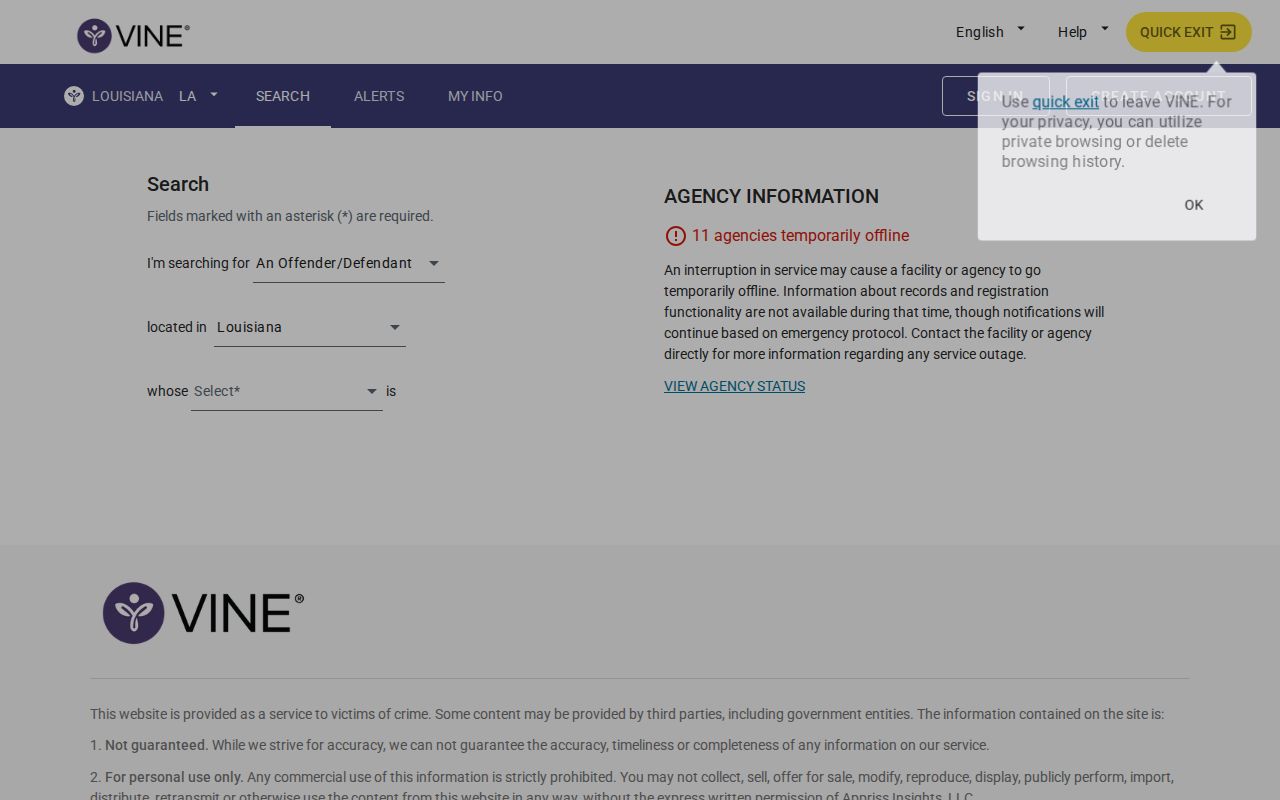
A current agency event can confirm the next stage, while a missing result still does not prove full discharge.
A transfer or detainer may also keep custody in place after the Committee acts. Follow any named receiving agency before describing the person as released to the community.
Louisiana Parole Eligibility Records
Louisiana parole eligibility cannot be reduced to a single fraction. R.S. 15:574.4 includes a general one-quarter provision for some otherwise eligible people, but it excludes or separately treats crimes of violence, sex offenses, fourth or later nonviolent felonies, juvenile or life cases, and offenses governed by different date ranges. The offense date, sentence, prior record, and statutory branch all matter.
An eligibility date marks the point at which consideration may occur. It is not a hearing date, grant, projected release date, or actual release. The proper check begins with the official sentence calculation and then moves to the Board schedule. DPS&C states that a newly sentenced case may await the court paperwork needed to calculate dates.
If the calculation is disputed, an imprisoned person in a state facility works through the facility Records Office. A state felon held locally uses the written Administrative Remedy Procedure described by DPS&C. Public copy should never attempt to rebuild the calculation from a docket alone.
Parole eligibility also differs from projected release. Eligibility permits consideration under the governing law. A projected date is a sentence calculation when applicable. A hearing date is an administrative setting. The actual release is the later custody event. Keeping all four dates labeled avoids turning a possible future step into release history.
Note: Apply the statutory eligibility branch tied to the offense date and sentence, not a general percentage found elsewhere.
Attend Louisiana Parole Hearings
Louisiana parole hearings are public, but access is hybrid. The Board describes observation through published Zoom or video arrangements, live YouTube, or in person at DPS&C headquarters when the current notice permits. The annual schedule gives the usual location as 703 South Boulevard in Baton Rouge unless a listing says otherwise.
Always use the current hearing notice. A method available for one panel may not govern the next. The rolling docket is the best place to identify the proceeding and its date, while the Board page supplies the broader public-participation framework. A person who plans to observe should confirm the notice instead of relying on an archived link.
The Board's general contact is paroleboard@la.gov, with mail directed to P.O. Box 94304, Baton Rouge, LA 70804-9304. Those contacts serve a statewide hearing question and are not a substitute for the named docket.
Observers should also distinguish access from participation. A public stream or in-person seat permits observation under the notice. Any right to submit information or address the panel follows the Board's rules for that proceeding. The current docket and Board instructions control, not an old video link.
Louisiana Three-Layer Hearing Check
Louisiana's most distinctive parole-record feature is the three-layer publication model. The annual calendar gives institutional rotation. Rolling weekly dockets identify people and proceedings. The legacy database carries searchable agendas and results. Each layer answers a different question, and skipping one can produce a false conclusion.
The same hearing date may have an agenda attachment and a later results attachment. A researcher must open both when needed and label the outcome from the final file. After a grant, status moves to a fourth source: the signed parole certificate and custody or supervision record. This chain keeps a scheduled hearing, decision, and actual gate release from being merged into one event.
Post-release requirements belong to the separate Louisiana parole and probation record. That source distinction is useful because the Committee grants parole while the Division of Probation and Parole supervises it.
After the signed certificate and actual release, LA VINE may show community supervision because DPS&C includes probation and parole records in its statewide feed. The assigned district is then the correct supervision contact. Much later, a Certificate of Discharge can mark sentence completion. That endpoint should not be confused with the original hearing results attachment.
Louisiana Parole Rehearing Records
The Board page summarizes general rehearing intervals after denial: one year for nonviolent matters, three years for a first violent offense subject to stated exclusions, and five years for second or later violent offenses, sex offenses, and listed serious cases. Those broad categories do not guarantee an exact future date.
Read the current policy, the denial result, and the person's applicable category together. Reconsideration under Board Policy 07-705 is not a formal appeal. A later docket confirms that the matter was actually scheduled again. Until then, a general interval is only part of the rule set.
This is another point where the annual calendar cannot answer the whole question. It may show a panel's institutional slot, but only the named docket confirms that a specific person appears in that hearing week.
After a denial, retain the decision attachment and its date. Then consult the live policy before estimating the next opportunity. Changes in classification, legal status, or governing policy can make a broad interval an unreliable forecast. The next named docket remains the best public confirmation of a new hearing.
Public Record Search
Sponsored Results