
Louisiana Parole and Probation Compared
Parole and probation can look alike because the Louisiana Division of Probation and Parole supervises both types of cases. Their legal sources differ. The Louisiana Board of Pardons & Committee on Parole decides discretionary parole, while a sentencing court imposes probation. A person on parole has left physical custody but is still serving the prison sentence. A person on probation serves a court-ordered community term that may follow, replace, or form part of confinement.
The distinction controls which record proves the end. Current Louisiana law makes parole discharge at full term an agency process when no listed legal block remains. Probation ends through the court. A locator result may help find an active assignment, but it does not replace either final document.
Physical release, active supervision, and final discharge are three separate points. A person may be absent from a prison roster yet appear under community supervision. Another person may have completed jail time but remain subject to court probation. A third may have reached the end of the whole term. Recording the status date and source helps keep those stages apart.
Good-time release adds another Louisiana-specific branch. Under the older diminution regime, R.S. 15:571.5 treats an eligible person released by diminution as if on parole for the balance of the original full term and calls for a certificate listing the conditions. For offenses committed on or after August 1, 2024, R.S. 15:571.3.1 generally places the unserved balance on unsupervised parole. The offense date and sentence decide which framework applies. Unsupervised parole is still a legal status, even though it does not mean ordinary field reporting.
| Point | Parole | Probation |
|---|---|---|
| Legal source | Prison sentence served in the community | Sentence or order imposed by a court |
| Decision-maker | Committee on Parole for discretionary release, or law governing diminution | Sentencing court |
| Public first check | LA VINE, then the assigned P&P district | LA VINE, assigned district, and court minutes |
| Strong endpoint record | Certificate of Discharge | Court termination or discharge order |
- Parole
- Release from confinement while the prison sentence continues under stated terms.
- Probation
- A community sentence imposed and ended by a court.
- Discharge
- The formal end of the applicable parole or probation term.
- Detainer
- An agency request or legal notice that can affect custody or discharge.
Verify Louisiana Post-Release Supervision
The official statewide starting point is Louisiana's LA VINE person search. The Louisiana Department of Public Safety & Corrections says its locator includes probation and parole community supervision and updates every 24 hours. Search results must be matched with care. A shared name, stale event, or record supplied by a different agency can produce the wrong conclusion.
- Search by the most exact name or available ID/case number. Narrow by location only when that detail is known.
- Open the matching record and compare the reporting agency, location, identifier, status, event date, and update marker.
- If the result indicates community supervision, use the DPS&C P&P office locator to identify the district that holds the assignment.
- Ask the district to confirm its own assignment within public-access limits. Do not infer an office solely from the parish of conviction.
- For probation, inspect the sentencing court's minutes or obtain the court order. For parole, seek the certificate or Board record that answers the exact question.
A county jail roster answers current jail custody, not statewide supervision. Once a person leaves that roster, the local movement record can show whether the exit was release, transfer, or another agency pickup. The statewide Louisiana parish directory routes that local part of the check.
The DPS&C locator instructions show the daily update rule and community-supervision scope.
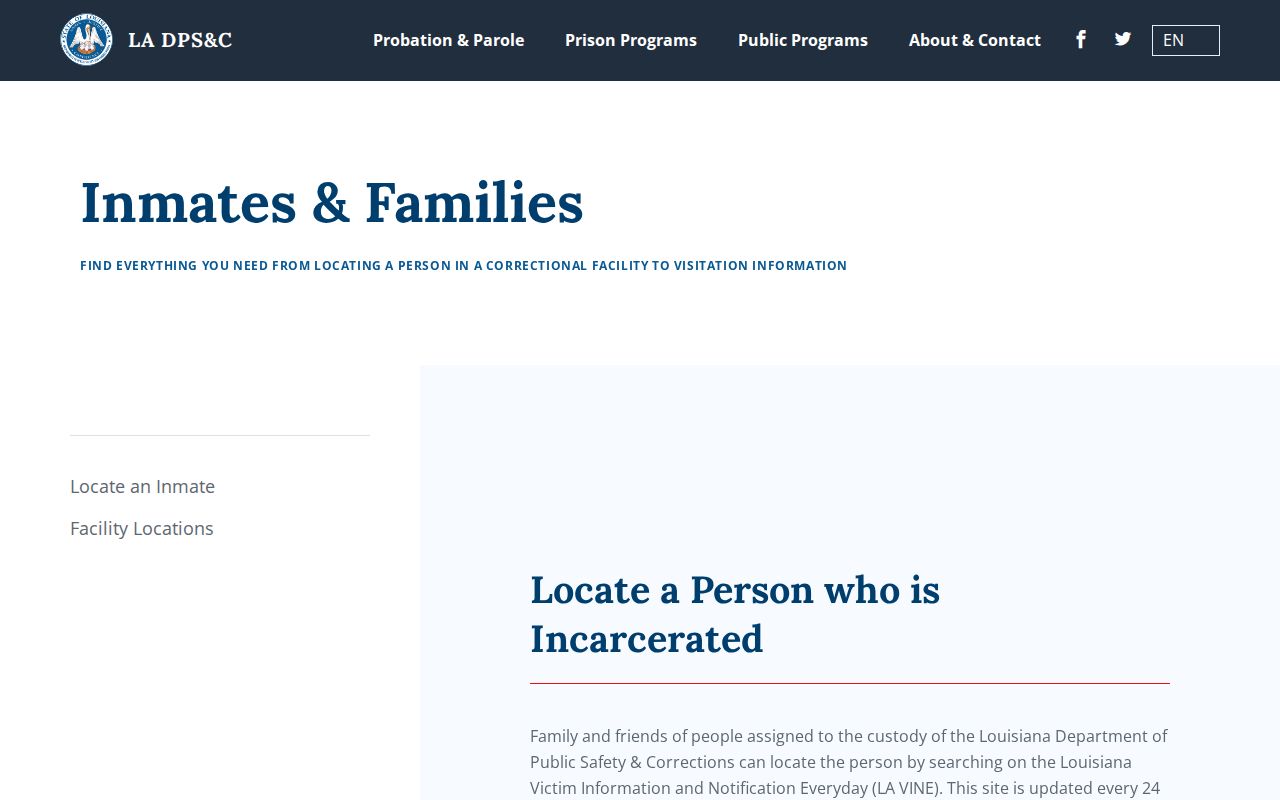
This screen supports using LA VINE as a dated snapshot, then confirming the assignment with the named office.
Louisiana Supervision Agencies
The Louisiana Board of Pardons & Committee on Parole and the Division of Probation and Parole have separate roles. The Committee on Parole is the state's parole-granting authority. P&P handles field supervision of felony probation, parole, and specified work-release matters. The January 2025 agency brochure identifies headquarters and twenty districts, which is why a single Baton Rouge address cannot stand in for a statewide assignment.
Louisiana supervision contacts
Board of Pardons & Committee on Parole
P.O. Box 94304
Baton Rouge, LA 70804-9304
225-342-9191 or 225-342-6622
paroleboard@la.gov
Division of Probation and Parole
Find the assigned district office
The official DPS&C home page identifies the department that houses these statewide correctional functions.

The department masthead confirms the official DPS&C name and avoids the informal LDOC label.
Office routing depends on assignment rather than geography alone. A conviction parish may point toward the court file, but it does not prove which P&P district supervises the case today. Transfers and statewide administrative decisions can change the responsible office. Give the district enough identity data to distinguish the person, then ask only for the public fact needed.
Louisiana Parole Conditions and Warrants
Louisiana R.S. 15:574.4.2 requires a parolee to report to the district named on the certificate, live at the approved address, and comply with reporting and other stated conditions. A dated DPS&C release brochure describes in-person reporting within 48 hours for good-time parole and granted parole. The live certificate and district instructions control current details. Proposed residence outside Louisiana should be addressed before release because travel and interstate supervision require approval and instructions.
No authoritative statewide public absconder or warrant list was found in the Louisiana research. That gap matters. A missing LA VINE result does not prove discharge, and a community status does not answer whether a warrant exists. An absconder is a supervised person whose location is unknown after failing to remain in contact. A warrant is a formal authority to arrest. Neither status should be guessed from an old web result.
For a suspected parole warrant or revocation, check the assigned district, the Committee docket when relevant, and the current custodial agency. A probation issue may instead appear in the sentencing court's minutes. The LA VINE search screen is still useful for the first status check.
A violation allegation is not the same as a completed revocation. The parole or probation authority must act through its own process, and a custody record can change while that process is pending. Use the latest dated record from each responsible office. If a person is taken into custody, identify whether the holder is a parish jail, DPS&C, or another sovereign before treating the event as a Louisiana supervision result.
Court and Board records answer different violation questions. A parole matter can appear on a Committee docket and in P&P records. A probation revocation belongs to the sentencing court, even though a P&P officer may supervise the term. Current jail custody only shows where the person is held now. It does not, by itself, identify whether a parole warrant, probation warrant, new charge, or another agency's hold caused the detention.
The Louisiana LA VINE interface supplies the statewide status screen shown here.
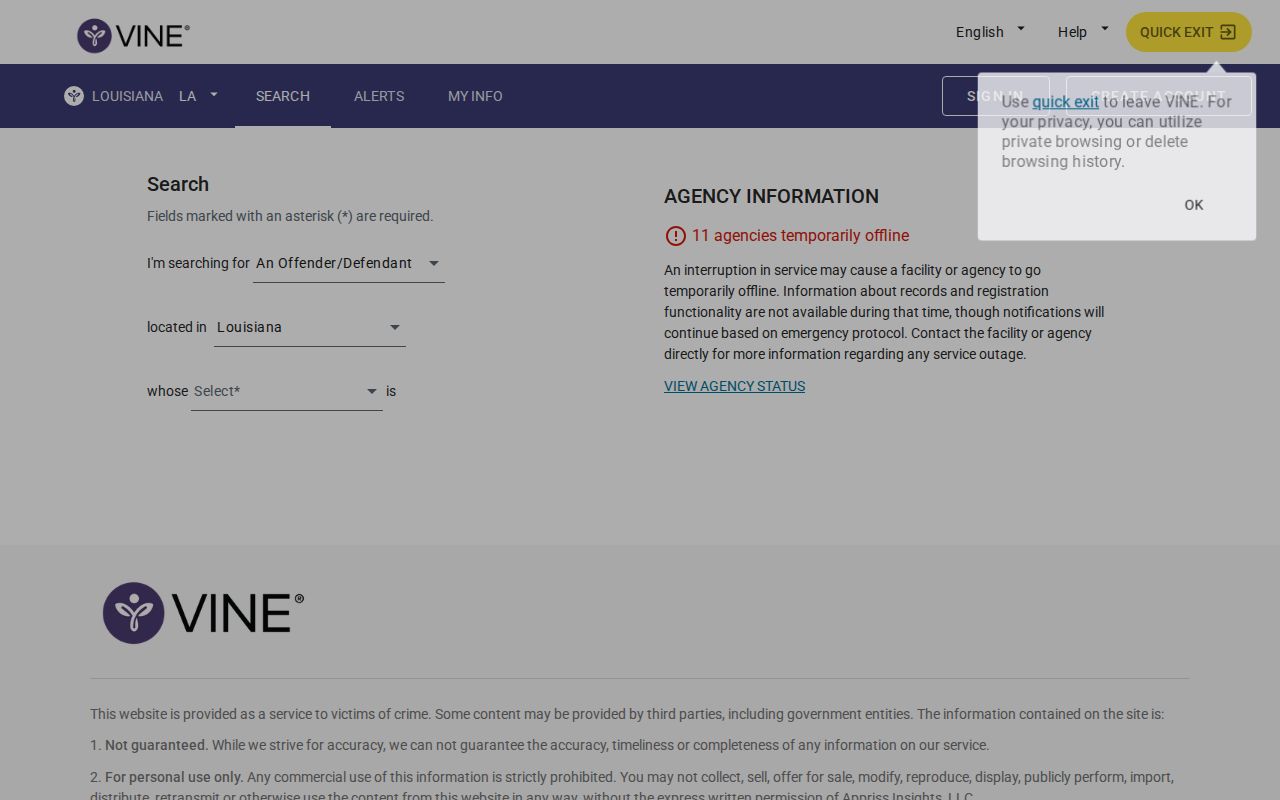
Its result must be read with the agency, event date, and update marker, not as a stand-alone warrant search.
Note: Public verification should never expose a supervised person's residential address or confidential case notes.
How Louisiana Parole Ends
Current R.S. 15:574.6, effective after its June 8, 2025 amendment, says parole runs for the rest of the sentence. DPS&C automatically discharges the parolee at full term without another Committee order only if no Committee warrant, P&P detainer, or pending felony indictment or bill tied to suspected parole conduct blocks discharge. Those are concrete legal checks, not optional web-search details.
Board Policy 15-1503 says the parolee receives a Certificate of Discharge when the sentence completes. It also says the Committee cannot terminate parole early. That certificate is much stronger proof than disappearance from LA VINE. The public locator has no published permanent retention promise for fully discharged people.
The broader distinction between physical release and full legal discharge is covered in the Louisiana released-inmates search.
When the full-term date arrives, retain the certificate and the date it was issued. If a statutory block exists, the expected endpoint may pass without automatic discharge. The assigned district can explain which office owns the current record, while the Committee or court supplies any formal action within its authority. A dated paper record is safer than relying on a locator screen that may later change or disappear.
Louisiana Probation Discharge Records
Probation follows a different endpoint path. Code of Criminal Procedure article 897 provides ways for a court to terminate and discharge probation, including a felony procedure that may be considered after one year, subject to statutory steps and exclusions. P&P supervises an assigned case, but the Division does not replace the judge as the source of judicial probation discharge.
Start with the court minutes. Look for the sentence, any modification, revocation event, termination, or discharge order. The district office may confirm that an assignment was active or closed within lawful limits, yet the court record explains why the probation term ended. When the web portal lacks the needed image or an older case is incomplete, request the record from the parish clerk.
This split prevents a common error. A parole Certificate of Discharge and a probation discharge order may both mark the end of supervision, but they come from different authorities and should not be treated as interchangeable.
Louisiana court minutes can also show a modification, early termination, or revocation that changes the expected endpoint. The statewide eClerks route may provide public minute entries for newer cases, but older or fuller records may remain with the parish clerk. A certified order should come from that clerk rather than from a screen capture.
Louisiana Certificate of Discharge
Louisiana's Certificate of Discharge is a distinctive statewide endpoint for parole. It records sentence completion after the agency checks for the statutory blocks to automatic full-term discharge. The document is more precise than a loose statement that a person is “off parole.” It identifies the legal event that ended parole authority.
Those blocks are limited but important. Current law names a Committee warrant, a P&P detainer, and a pending felony indictment or bill arising from conduct suspected during parole. Their absence permits the automatic full-term process described by the statute. Their presence calls for agency and court verification. It should not be inferred from rumors, a stale status page, or a missed reporting date.
To verify one, ask the person or DPS&C for the narrow record that answers the discharge question. Do not seek a whole confidential institutional file. If the certificate cannot be produced, contact the assigned P&P district and give enough identifying detail to distinguish the case. A Board hearing result is not a substitute because a favorable parole decision comes before release and later discharge.
The DPS&C Victim Services page illustrates how Louisiana separates current status tools from formal notice programs.
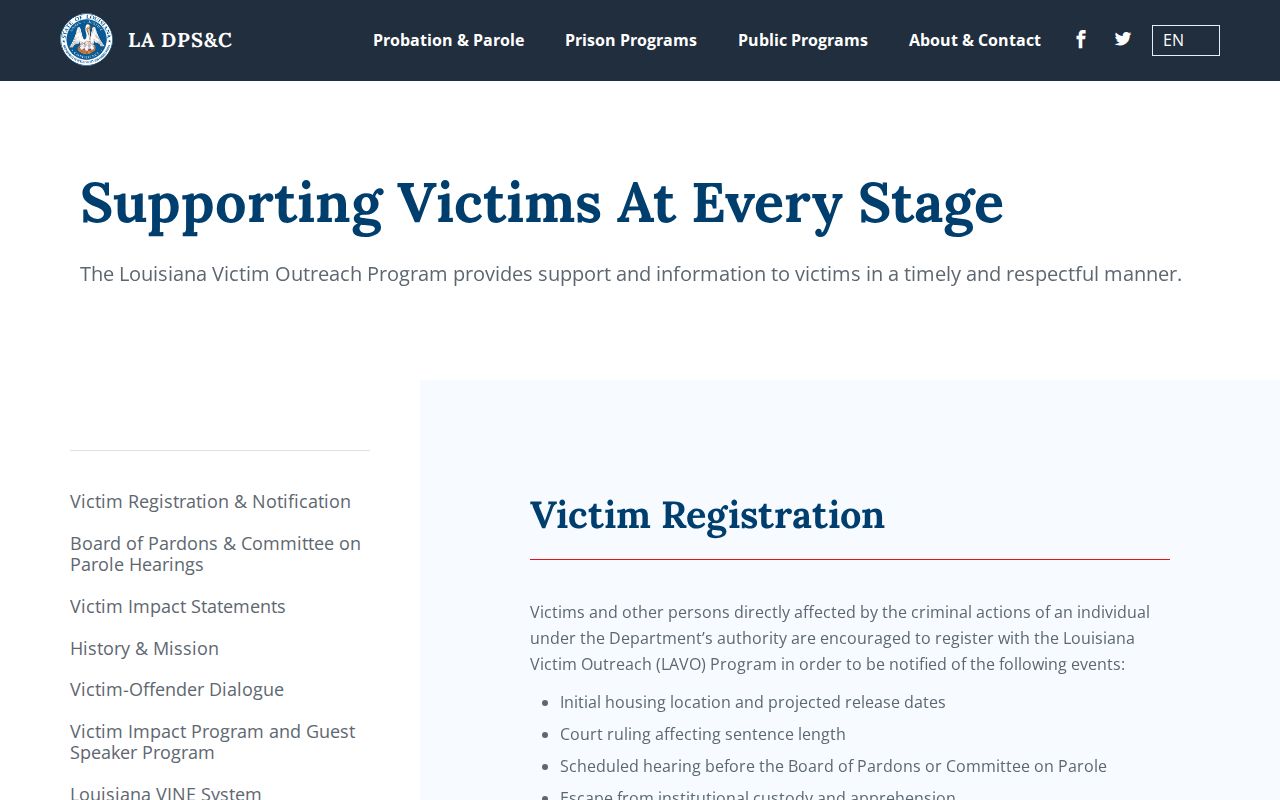
That separation reinforces the need to obtain the actual certificate when the question is whether parole has legally ended.
Public Record Search
Sponsored Results