
Louisiana VINELink Release Coverage
Louisiana's program began as LAVNS and is now styled Louisiana Victim Information and Notification Everyday, or LA VINE. The public can use VINELink's Louisiana person search or call 866-528-6748. The Louisiana Department of Public Safety & Corrections says the locator includes imprisoned people and people under probation or parole community supervision. That scope is useful after physical release because a community sentence can remain visible.
LA VINE receives data from contributing agencies. Published fields and event labels can vary by source. DPS&C says its data update every 24 hours, so the service is a dated verification snapshot. It is not a permanent statewide archive of everyone once held, and no official source promises that a fully discharged person's record stays public for a set period.
The service covers custody and community-supervision questions, but the reporting agency owns the underlying fact. A parish entry may describe a jail event. A DPS&C entry may describe state custody or P&P supervision. Reading those records as if they came from one database owner would hide the source of the status.
Louisiana also provides a 24-hour telephone path through LA VINE. The phone option can help when web access fails, but it draws from the same agency-fed system. It should not be described as a separate historical archive or a faster gate notice. Record the time of the call and confirm urgent custody questions with the responsible agency.
The official Louisiana search interface is the direct public starting point.
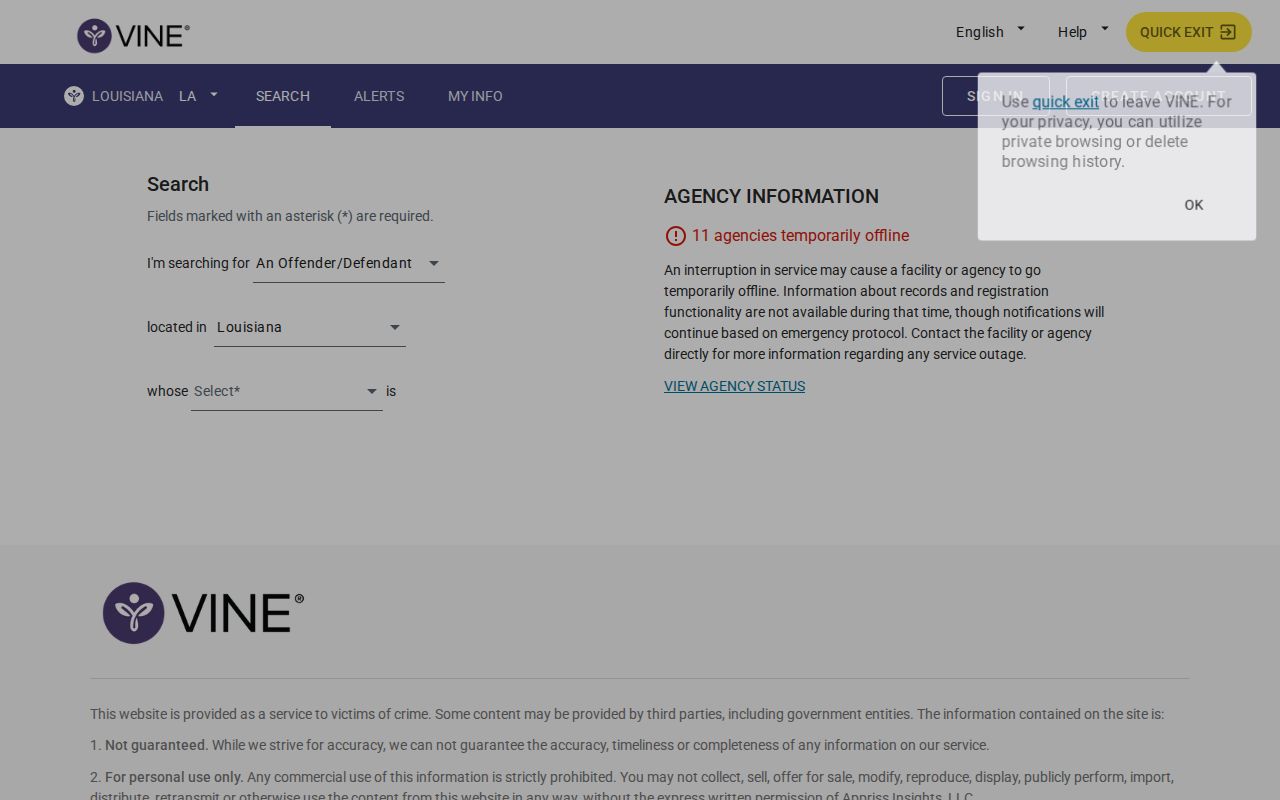
The screen supports a named-person check without claiming a staged or universal released-result label.
Search a Louisiana Person on VINELink
Begin with the most exact identity data available. VINELink supports name and ID/case-number searches, with location as a useful filter. A broad name may return several records. Never choose a result only because the name looks right. Compare the agency, location, identifier, event date, and other displayed details before opening or reporting it.
- Open the Louisiana person search and confirm that Louisiana is the selected state.
- Enter the exact first and last name, or use the known ID/case number.
- Narrow by location only when the person's last custodian or parish is known.
- Compare all available identifiers before opening a matching record.
- Read the reporting agency, location, status or event, date, and update marker exactly as displayed.
- Follow any named receiving custodian when the event may describe a transfer.
A parish roster disappearance is not enough. The local jail may have released the person on bond, completed a sentence, transferred the person to DPS&C, or handed custody to another sovereign. Use the Louisiana parish directory to reach the local record owner when the statewide result cannot explain the movement.
Search spelling matters. Try the exact legal name first and compare any initials or suffixes shown in the source record. If a name-only query returns no match, use the known agency ID rather than guessing at a new identity. A person can also have separate records from different custodians, so match each event to its reporting agency.
The DPS&C locator instructions state the supported inputs and daily update pattern.
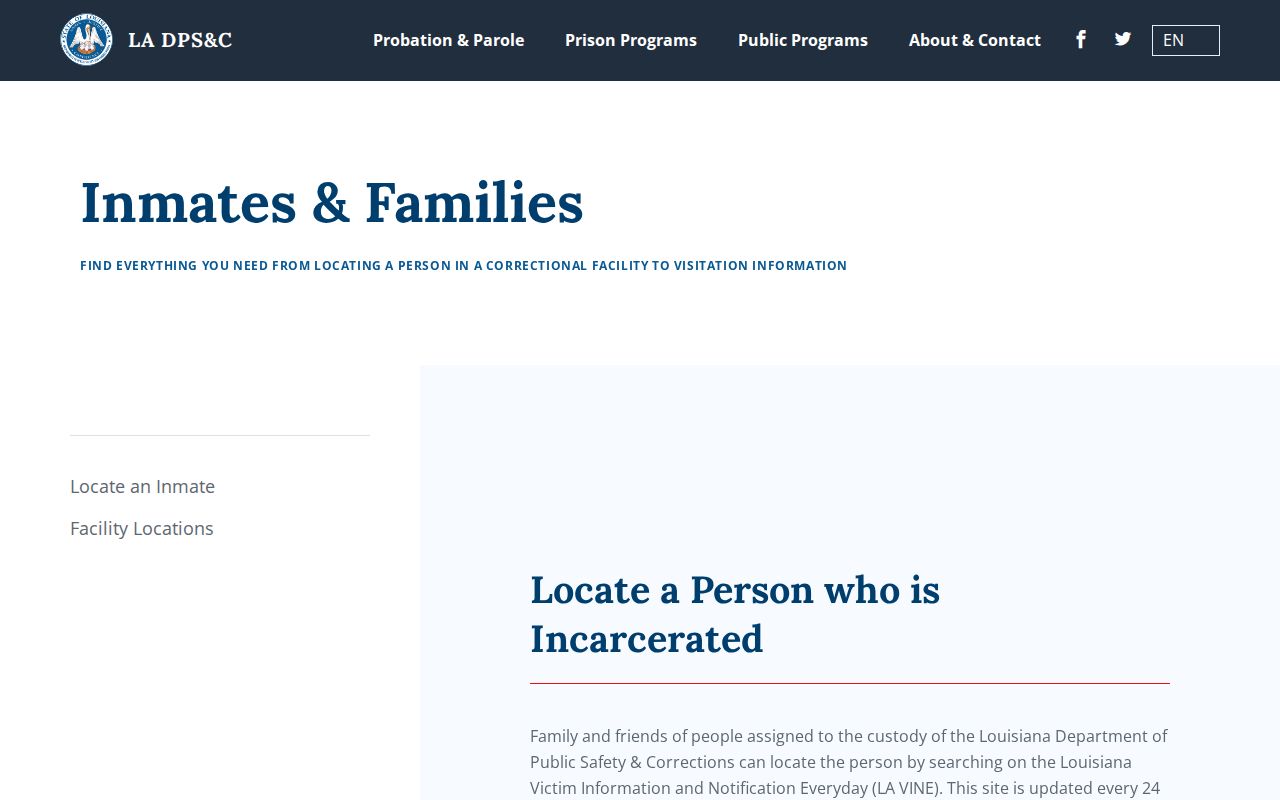
Those instructions also confirm that community-supervision records can remain relevant after prison confinement ends.
Louisiana VINELink Release Fields
VINELink does not publish one fixed result-card schema for every Louisiana contributor. The responsible method is to preserve the labels seen in the current record. Do not promise that each result contains an actual release date, scheduled date, release type, or a word such as “Discharged.” The supplying agency and case stage control what appears.
| Field or element | How to read it |
|---|---|
| Name and identifier | Use both to separate people with similar names |
| Reporting agency | Shows which contributor supplied the record |
| Location | May identify a facility, parish, or community-supervision assignment |
| Status or event | Read the exact current wording without substituting a broader conclusion |
| Event date | Dates the displayed custody or supervision change when supplied |
| Update marker | Helps judge how recent the agency-fed snapshot is |
A release or out-of-custody event proves departure from that reporting custodian when the agency supplies it. It may not mean release to the community. Another parish, DPS&C, the Federal Bureau of Prisons, U.S. Marshals Service, or ICE may hold the next record.
Scheduled and actual dates must remain distinct. DPS&C only confirms the phrase “projected release date (if applicable)” for its automated telephone locator. The agency does not promise that this field appears on every VINELink web record. Report only what the live result shows and date the observation.
A community-supervision location also needs care. It can show that confinement ended while legal supervision continues, but it does not establish the person's home address or full case details. Use the P&P office locator for the assigned district and protect private residential data. Public status verification does not require publishing where a person lives.
Register Louisiana VINELink Release Alerts
VINELink can register available custody-status notifications on the selected record. Louisiana materials describe phone, email, text, and TTY channels. Options can vary with the reporting agency and event. Registration should be tied to the correct person record after identity is checked, because alerts repeat the source agency's data rather than independently verifying it.
- Open the verified Louisiana record and select the available notification option.
- Choose the offered delivery method, such as phone, email, text, or TTY.
- Enter accurate contact information and complete the confirmation steps shown by the service.
- Set and retain any PIN the registration flow requires for phone notices.
- Keep contact details current and save the registration confirmation.
- When an alert arrives, confirm the event with the reporting or receiving agency.
The DPS&C Victim Services page describes LA VINE status access and the state's separate notice services.
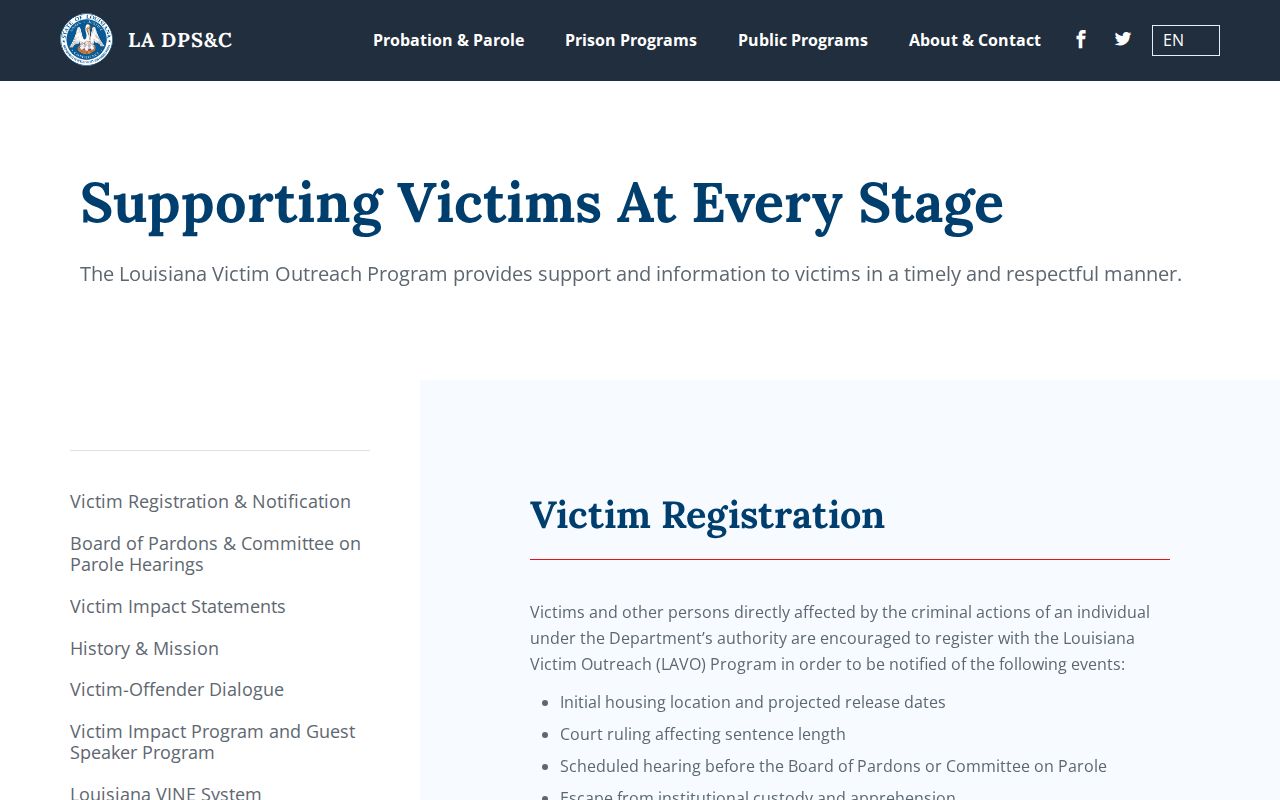
Its wording is important because public locator registration and formal state-prison victim notice are not the same enrollment.
LA VINE Versus LAVO
Louisiana draws a crucial line between an ordinary LA VINE/VINELink record registration and the Louisiana Victim Outreach Program, called LAVO. DPS&C says an eligible registrant presently must use LAVO for formal state-prison notices that can include a projected release date, actual release by any means, a sentence-changing ruling, pardon or parole hearing, escape, or transitional-work placement.
A local VINELink alert does not automatically create LAVO registration. The formal LAVO process has four steps and depends on accurate, current contact information. Victim Services lists 225-342-1056, 888-342-6110, and victimservices@la.gov for its program.
Formal notice scope is also broader than one custody-status alert. DPS&C lists state-prison events such as sentence-changing rulings, pardon or parole hearings, and transitional-work placement among the LAVO notice categories. Eligibility and enrollment remain governed by that program. A person should use the formal page and Victim Services contact instead of assuming a VINELink confirmation covers every notice.
Contact details must stay current after registration. A valid enrollment cannot deliver a call, text, email, or letter to an abandoned channel. Keep the confirmation and update the formal program when information changes. For a state-prison event, ask Victim Services which registration controls rather than creating duplicate assumptions from similar program names.
The official LAVO registration page shows the separate formal route.
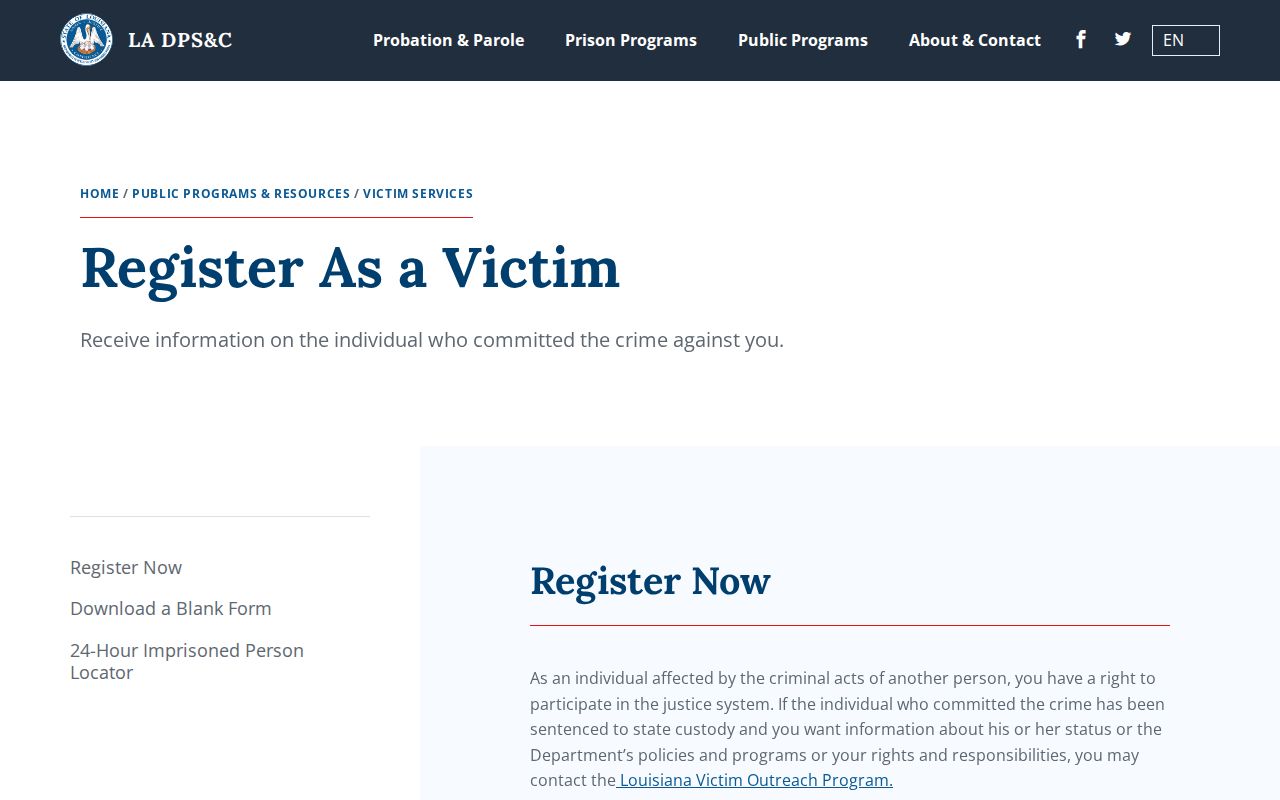
This distinction prevents a local alert subscription from being mistaken for all notices available through the state-prison outreach program.
Louisiana VINELink Release Limits
No authoritative statewide list of nonparticipating Louisiana parishes was found. The defensible caveat is narrower: agency feeds and their fields vary, the published DPS&C refresh is every 24 hours, and a person may cross local, state, federal, or immigration jurisdictions. A stale result or no match can reflect spelling, identity data, feed lag, a parish-only booking, another custodian, or the end of the public system's scope.
VINELink is not the Federal Bureau of Prisons locator. For a federal sentence, use BOP's separate search and read whether the result shows a past release date, a future projection, “RELEASED,” or “Not in BOP Custody.” ICE's Online Detainee Locator is current-custody-oriented and also requires its own exact search. Neither system is resolved by a Louisiana VINELink result.
When a parish reports release to ICE, the event may be a transfer. An ICE detainer is only a request to hold someone for up to 48 hours beyond ordinary release so ICE can assume custody. It does not prove the handoff occurred. Check the jail movement record and the receiving locator.
Federal results have their own vocabulary. BOP says a past date with no facility can mean release on that date, a future date is projected, and “UNKNOWN” means the term is undetermined. “RELEASED” or “Not in BOP Custody” resolves BOP custody only. It does not answer state supervision, another jurisdiction, or federal supervised release.
Note: Treat every alert as a prompt to verify the current event with the agency that supplied or received the record.
Confirm a Louisiana VINELink Release
Confirmation follows the legal custodian. If a parish jail supplied the result, ask that sheriff or jail for the movement or release record. If a state sentence is possible, call the DPS&C automated locator at 225-383-4580 with the DPS&C number or the person's name and date of birth. The line can provide a facility assignment and, when applicable, the agency's projected release date.
For a person shown under probation or parole, find the assigned P&P district and verify its role. For a federal record, use BOP. For immigration custody, use ICE. Court minutes can explain bond, dismissal, sentence, probation, revocation, or commitment, but the custodian's movement record is the source for the physical event.
Keep a simple source log: search date, exact identity inputs, reporting agency, displayed status, event date, and next custodian checked. This guards against later feed changes and prevents a projection from being repeated as history. When the answer remains unclear, request the narrow movement or release record from the agency that last held the person.
A narrow request can ask for the date and destination of a specific movement without demanding a whole confidential file. Include the full name, the agency ID when known, and a useful date range. If the event involved a court order, obtain the related minute entry too. Together, the custodian record and legal authority explain both what physically happened and why.
The full source ladder appears in the Louisiana released-inmates search. The main point remains simple: match identity first, read the exact VINELink event, then confirm the next custodian before calling the person released to the community.
Public Record Search
Sponsored Results