
Louisiana Projected Versus Actual Release
A projected release date is forward-looking. DPS&C calculates it from the sentence and the records then on file. An actual release date records an event that has already occurred. A parole eligibility date marks the earliest point when a person may qualify for consideration, not a promised exit. A hearing date only sets a proceeding. Keeping those terms apart prevents a forecast from becoming a false claim about release.
Pretrial detainees usually have no sentence-based projection because the court has not imposed a term. Their next event may depend on bond, dismissal, a plea, trial, or another court order. A newly sentenced person can also lack a calculated date while DPS&C waits for the official sentencing papers. The state expressly qualifies its public term as “projected release date (if applicable).”
The DPS&C inmate-information page states the official projected-date wording.
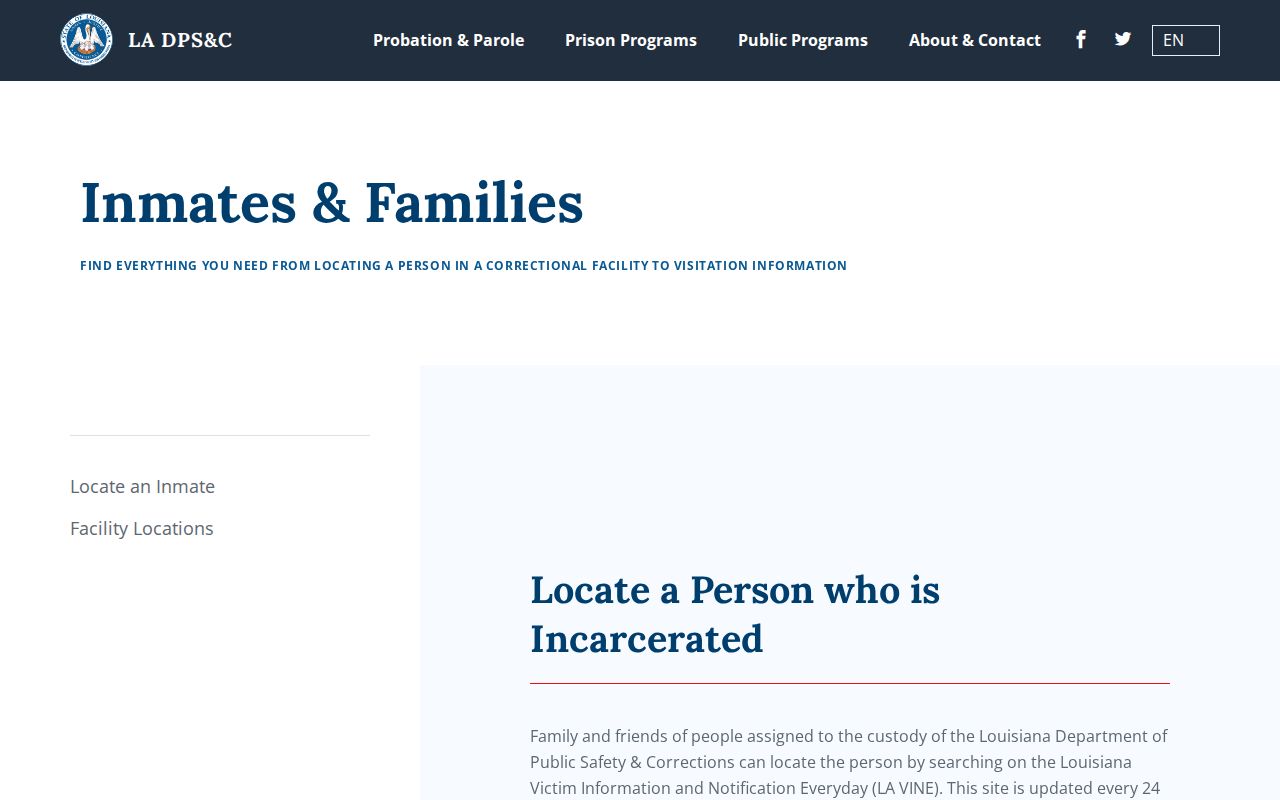
It also establishes the locator's inputs and the public data's 24-hour update cycle. That cadence makes the record a dated snapshot, not a live prison-gate clock.
Find a Louisiana Inmate Release Date
The verified statewide channel is the automated DPS&C Imprisoned Person Locator at 225-383-4580. Supply the DPS&C number, or the person's name and date of birth. The line can return a facility placement, contact information, and a projected release date when one applies. The public research does not show that LA VINE always displays the same projection field online, so use the phone route for that exact item.
- Decide whether the sentence belongs to DPS&C, a parish jail, the federal Bureau of Prisons, or another custodian.
- For a state sentence, call the automated locator with the DPS&C number or exact name and date of birth.
- Write down the projected date exactly and note when it was obtained. Do not relabel it as actual release.
- Check LA VINE for the current custody or community-supervision record and compare the reporting agency.
- On or after the expected date, verify the event with the releasing facility and follow any stated receiving agency.
A parish sentence is computed locally, even when a state law supplies the good-time rule. Contact the sheriff or parish records unit and review the sentencing court's minutes. State-sentenced people may be housed in local facilities, however, so legal custody matters more than the building. The DPS&C Offender Search page explains that state and parish split.
Note: DPS&C sentence-computation questions use 225-342-0799; the public-records mailbox is not a calculation service.
Louisiana Sentence Calculation Records
DPS&C cannot complete a new calculation until it receives the official court paperwork. Once calculation is complete, the agency sends the imprisoned person a Master Prison Record. That formal record can show the calculation and may carry “WRE,” the notation for work-release eligibility. A state-facility prisoner raises a calculation question through the facility Records Office. A state felon housed in a local facility uses the written Administrative Remedy Procedure.
The official calculation is safer than arithmetic based on a court docket alone. Jail credit, concurrent and consecutive terms, amended judgments, the offense-date version of the law, eligibility exclusions, prior convictions, forfeiture, and later custody events can all affect the date. Concurrent terms run at the same time. Consecutive terms run one after another. A docket may explain the sentence but still omit how DPS&C applied credits.
| Record or channel | What it can establish | Limit |
|---|---|---|
| DPS&C phone locator | Projected release date, if applicable | Snapshot, not proof of actual exit |
| Master Prison Record | Formal DPS&C sentence calculation | Issued to the imprisoned person after calculation |
| Sentencing court minutes | Sentence, credit order, amendment, or revocation | May not show final agency arithmetic |
| Facility or sheriff record | Actual movement or release event | Covers that custodian only |
The official DPS&C home page identifies the agency that maintains state sentence and release records.

The agency route, not an unofficial sentence calculator, is the authority for a Louisiana state commitment.
Louisiana Good-Time Offense-Date Divide
Louisiana now has a sharp line based on when the offense occurred. Earlier cases remain under the detailed branches of R.S. 15:571.3. For an eligible parish prisoner sentenced without hard labor, that law provides 30 days of diminution for each 30 days in actual custody, with a lower three-for-seventeen rate for a first crime of violence. “Diminution” means a reduction in time through earned good-time credit.
For eligible people in DPS&C felony custody under the older regime, the statute contains a thirteen-for-seven baseline. It also includes one-for-three treatment for specified first violent offenses and one-for-two treatment for a fourth or later nonviolent felony, subject to the statute's dates and exclusions. Sex offenses, habitual-offender treatment, violent-offense classifications, prior history, and other limits can change or bar credit. No single ratio fits every older case.
For an offense committed on or after August 1, 2024, R.S. 15:571.3.1 applies. An eligible felony offender in parish prison or DPS&C custody may earn good time up to 15% of the particular sentence imposed. Sex-offense and habitual-offender sentences are excluded. Presentence time credited under Code of Criminal Procedure article 880 earns no good time under this section, though separate program credit may apply under its own law.
| Offense period | Framework | Public takeaway |
|---|---|---|
| Before August 1, 2024 | R.S. 15:571.3 branches by custody and offense class | Multiple ratios and exclusions require the official case calculation. |
| On or after August 1, 2024 | R.S. 15:571.3.1 generally caps eligible good time at 15% | Eligibility and forfeiture still matter; it is not automatic. |
This date divide is why a general web calculator would mislead. DPS&C decides when credit has been earned and allowed. The projected release date from the state remains the working public answer.
Louisiana Good-Time Release Supervision
A reduced prison term does not always mean the full sentence has ended. Under the older framework, R.S. 15:571.5 generally releases a person by good-time diminution as if on parole for the balance of the original full term. The release certificate lists conditions, and a violation may lead to revocation and recommitment.
For covered offenses on or after August 1, 2024, the newer law generally places the rest of the original term on unsupervised parole. A probation term in a split sentence begins on release and may run at the same time. Unsupervised parole is still part of the legal sentence. It should not be described as full discharge merely because routine reporting is absent.
- Good time
- Credit that may reduce confinement when the person and sentence qualify.
- Unsupervised parole
- The remainder of a sentence served outside confinement under the newer statutory structure.
- Split sentence
- A sentence that combines confinement with a probation period.
- Full term
- The original sentence endpoint before an earlier release from physical custody.
Formal completion has its own proof. Board policy says a parolee receives a Certificate of Discharge when the sentence ends. Probation ends through the court. Neither endpoint should be inferred from a missing locator result.
Why Louisiana Release Dates Change
A projection reflects the record and credits available when DPS&C calculated it. R.S. 15:571.4 allows forfeiture of good time and credits toward the projected good-time parole supervision date in stated circumstances. The date may also move when sentencing documents arrive, an error is corrected, jail credit changes, a court amends a judgment, or concurrent and consecutive terms are interpreted.
| Factor | Possible effect | Who confirms it |
|---|---|---|
| Good-time credit earned | May move an eligible projection earlier | DPS&C or the sheriff |
| Credit forfeiture | May move the projected supervision or release point later | DPS&C or the sheriff |
| Court papers or amendment | Can alter the sentence or its start and sequence | Sentencing court and calculating custodian |
| Jail credit | Changes time credited toward the term | Court record and calculating custodian |
| Detainer or new custody | May prevent community release even if one term ends | Releasing and receiving agencies |
| Parole action or revocation | Can change the route, conditions, or return to custody | Committee on Parole and DPS&C |
A detainer is a request or notice tied to another authority's possible custody. It does not itself prove pickup. A parole grant also does not prove that the person passed through the gate. Actual movement must be checked with the facility and any receiving system.
Note: Preserve each projected date with its retrieval date because later credits, orders, or custody events can change the official calculation.
Verify Louisiana Actual Release
On the expected release date, search LA VINE by exact name or ID and compare the reporting agency, location, status, event date, and update marker. DPS&C says the statewide feed updates every 24 hours. That means a status can lag the actual gate event. It also means an old projection should not outrank a newer facility or court record.
The Louisiana LA VINE screen provides the statewide person-search route.
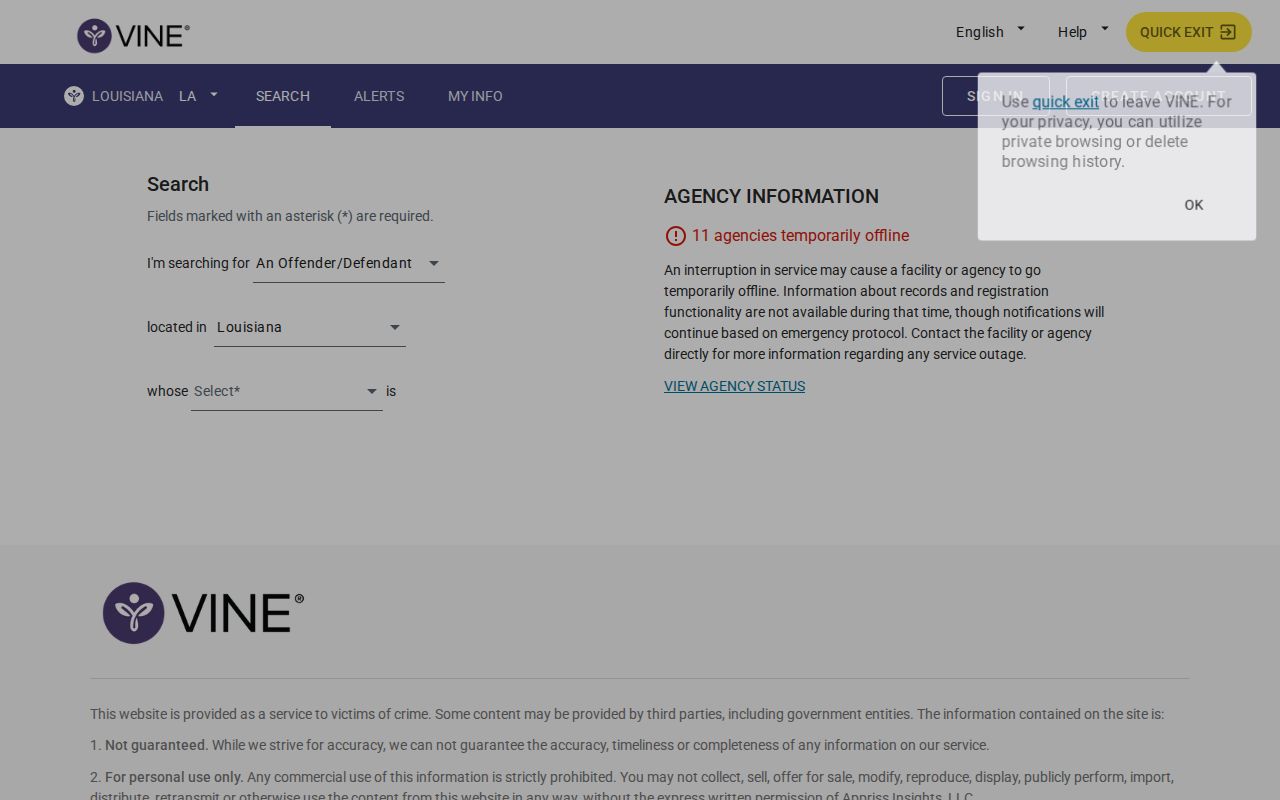
LA VINE can show custody or community supervision from participating agencies, but its exact live label must be quoted rather than guessed. No result is not proof of discharge.
Formal state-prison notices require one more distinction. Registering for an alert on a local LA VINE record is not the same as formal Louisiana Victim Outreach registration. DPS&C says eligible LAVO registrants may receive notices of a state-prison projected date, actual release by any means, sentence-changing ruling, hearing, escape, or transitional-work placement.
The DPS&C Victim Services page explains the two notification paths.

For a status check, LA VINE remains the public route. Formal LAVO registration serves the eligible notice process and requires current contact information.
Other Louisiana Release-Date Custodians
The state projection does not answer every Louisiana custody case. A parish court and sheriff control the path for a local pretrial or parish-sentence matter. The BOP locator handles federal sentences and distinguishes past release dates from future projections. ICE's locator is mainly a current-custody search and a failed match is not proof of release. Follow the sovereign that owns the sentence.
| Custody path | Date source | Verification |
|---|---|---|
| DPS&C state sentence | Automated locator and Master Prison Record | LA VINE, facility, and assigned P&P district |
| Parish custody | Sheriff records and sentencing court | Release or movement record |
| Federal BOP sentence | BOP Inmate Locator | Federal docket and BOP status |
| Immigration detention | ICE ODLS for current custody | ERO and the prior custodian's movement record |
Louisiana court minutes may explain sentence credit, probation, revocation, or commitment. They may not show the exact gate time. Older cases, certified copies, and missing images remain parish-clerk matters, while the custodian's movement record confirms physical departure.
The BOP result vocabulary is more explicit than the Louisiana state route. A past date without a facility indicates release from BOP custody on that date. A future date is projected, “UNKNOWN” means the term is not yet determined, and “RELEASED” or “Not in BOP Custody” means the person has left BOP custody. Daily extraction and later First Step Act calculations can still change a federal projection. None of those labels settles Louisiana state, parish, immigration, or community-supervision status.
ICE requires a different reading. Its Online Detainee Locator is built chiefly for people now in ICE custody or held by CBP beyond 48 hours. Exact identifiers matter, and a failed search can reflect delay or withheld data. When a parish release record notes an ICE detainer, confirm the actual handoff with both the jail movement record and ICE or ERO. A detainer request alone does not establish that immigration custody began.
The LAVO registration page shows the formal state-prison notice process.

This formal path is separate from a routine VINELink alert and should be used only by people who meet its registration rules.
Public Record Search
Sponsored Results